【新文速递】2026年1月4日固体力学SCI期刊最新文章
今日更新:International Journal of Solids and Structures 2 篇,Journal of the Mechanics and Physics of Solids 2 篇,Thin-Walled Structures 3 篇
International Journal of Solids and Structures
Exact ana lysis of bending of a simply supported heterogeneous plate with irregularly-shaped inclusions
Emad Hasrati, Ankur Jain
doi:10.1016/j.ijsolstr.2025.113828
含不规则夹杂物的简支非均质板弯曲的精确分析
Composite and functionally graded materials are used commonly in a broad variety of engineering systems. This work presents theoretical bending an alysis of a simply supported heterogeneous rectangular plate containing discrete inclusions of irregular shapes. The commonly available governing equation for a homogeneous plate is generalized by accounting for inclusions of irregular shapes and mechanical properties embedded within the plate. The heterogeneous plate problem is then solved by representing the spatial distribution of elastic mod uli and Poisson’s ratios using Heaviside functions, thereby enabling an efficient modeling of sharp discontinuities in these properties at the plate-inclusion interfaces. A series solution for the displacement field is derived using the integral and differential properties of the Heaviside function. The derivation is an exact generalized approach to handle multi-inclusion configurations with nonuniform properties, in contrast with previously presented approximate techniques such as homogenization and laminate approximation. Results are shown to reduce to the well-known Navier solution under special conditions. Good agreement with independent finite-element simulations is also shown. A key finding of this work is that the location and shape of discrete inclusions, particularly their intersection with the high-bending regions of the plate, significantly influence the magnitude and also the spatial distribution of transverse deflection. Notably, stiff inclusions tend to displace the deflection peak away from themselves, while soft inclusions attract it, and in both cases, proximity to the plate boundaries can reverse these trends due to geometric and support-induced constraints. The technique developed here enables ana lysis of a number of practical problems comprising heterogeneous composites, as demonstrated through several examples. In addition to extending the state-of-the-art in theoretical a nalysis of composite structures, this work may also find practical applications in a number of engineering systems where such materials are used commonly.
复合材料和功能梯度材料广泛应用于各种工程系统中。这项工作提出了包含不规则形状离散夹杂物的简支非均质矩形板的理论弯曲分析。一般可用的均匀板的控制方程是通过考虑不规则形状的夹杂物和嵌在板内的力学性能来推广的。然后通过使用Heaviside函数表示弹性模量和泊松比的空间分布来解决非均质板问题,从而能够有效地模拟板-包裹体界面上这些属性的尖锐不连续。利用Heaviside函数的积分和微分性质,导出了位移场的级数解。与先前提出的近似技术(如均匀化和层压近似)相比,该推导是一种精确的广义方法来处理具有非均匀性质的多包含配置。结果表明,在特殊条件下,其解可约化为众所周知的纳维耶解。与独立有限元模拟结果吻合较好。这项工作的一个关键发现是,离散夹杂物的位置和形状,特别是它们与板块高弯曲区域的相交,显著影响横向挠度的大小和空间分布。值得注意的是,硬包裹体倾向于将偏转峰从自身移开,而软包裹体则吸引它,在这两种情况下,由于几何和支撑诱导的约束,靠近板块边界可以扭转这些趋势。本文开发的技术可以分析包含异质复合材料的许多实际问题,如通过几个示例所演示的那样。除了扩展复合材料结构理论分析的最新技术外,这项工作还可以在许多通常使用这种材料的工程系统中找到实际应用。
Shape and topology optimization for contact applications
Filip Sjövall, Mathias Wallin
doi:10.1016/j.ijsolstr.2025.113825
接触应用的形状和拓扑优化
This paper combines density-based topology optimization (TO) with a “contact aware” shape optimization (SO) which combines the design freedom of TO with the precise boundary representation of SO. Using gradient based optimization, the objective is to design structures in frictionless contact, including the shape of the contacting surfaces. SO is performed on each contacting structure which defines its own TO domain and contact is modeled at the interface between the domains using a mortar formulation combined with the penalty method. The SO uses the finite element node coordinate parameterization, and to avoid undesired shape changes that can result in e.g. jagged boundaries or excessive interference between two contacting grids, a PDE-based filter is used. Two formulations are investigated, one that sequentially uses TO and then SO and one that uses them simultaneously.
本文将基于密度的拓扑优化(TO)与“接触感知”形状优化(SO)相结合,结合了TO的设计自由度和SO的精确边界表示。利用基于梯度的优化,目标是设计无摩擦接触的结构,包括接触面的形状。每个接触结构都定义了自己的TO域,并在域之间的界面上使用砂浆配方结合惩罚法对接触进行建模。SO使用有限元节点坐标参数化,为了避免可能导致锯齿边界或两个接触网格之间过度干涉的不希望的形状变化,使用了基于pde的滤波器。研究了两种配方,一种顺序使用TO,然后使用SO,另一种同时使用它们。
Journal of the Mechanics and Physics of Solids
A unified multi-perspective quadratic manifold for mitigating the Kolmogorov barrier in multiphysics damage
Qinghua Zhang, Stephan Ritzert, Jian Zhang, Jannick Kehls, Stefanie Reese, Tim Brepols
doi:10.1016/j.jmps.2025.106499
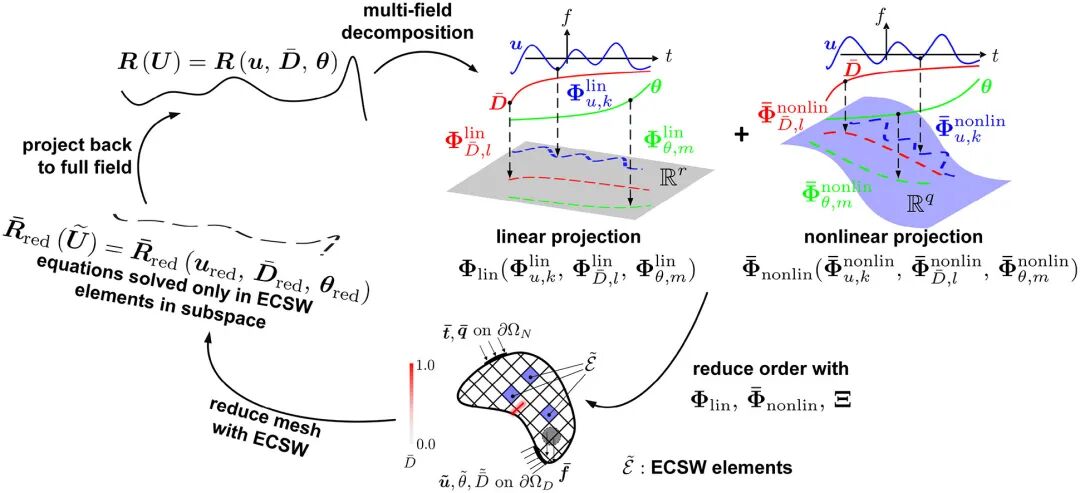
用于减轻多物理场损伤中Kolmogorov势垒的统一多视角二次流形
In multiphysics damage problems, material degradation is often modeled using local and/or global damage variables, whose evolution introduces strong nonlinearities and significant computational costs. Linear projection-based reduced-order models (ROMs) are widely used to accelerate these simulations but often fail to capture complex nonlinear damage evolution effectively. This limitation arises from the slow decay of the Kolmogorov n-width, which leads to a phenomenon known as the Kolmogorov barrier in linear approximation. To overcome this challenge, this study proposes a novel unified multi-perspective (multi-field and multi-state) quadratic manifold-based ROM framework for thermo-mechanically coupled damage-plasticity problems. A key feature lies in a multi-field and multi-state decomposition strategy that is grounded in the material’s physical response to guide the selection of mode numbers for each coupled field. Moreover, the framework decouples both material states and physical fields, providing clearer insights into the contributions and interactions of each field within the overall multiphysics simulation. Benchmark tests demonstrate that the proposed approach mitigates the Kolmogorov barrier of linear projection-based ROMs by ensuring a s mooth and monotonic decrease in error as the number of modes increases. The proposed multi-perspective quadratic manifold framework offers a robust and flexible approach for efficiently reducing complex damage-involved multiphysics problems and shows the potential for industrial applications.
在多物理场损伤问题中,材料退化通常使用局部和/或全局损伤变量来建模,这些变量的演化引入了强非线性和显著的计算成本。基于线性投影的降阶模型(ROMs)被广泛用于加速这些模拟,但往往不能有效地捕捉复杂的非线性损伤演化。这种限制源于柯尔莫哥洛夫n-宽度的缓慢衰减,这导致线性近似中的柯尔莫哥洛夫势垒现象。为了克服这一挑战,本研究提出了一种新的统一的多视角(多场和多态)二次流形ROM框架,用于热-机械耦合损伤-塑性问题。其关键特征在于基于材料物理响应的多场多态分解策略,以指导每个耦合场的模态数选择。此外,该框架解耦了物质状态和物理场,为整个多物理场模拟中每个场的贡献和相互作用提供了更清晰的见解。基准测试表明,该方法通过确保误差随模态数量的增加而平滑单调地减小,从而减轻了基于线性投影的rom的Kolmogorov障碍。所提出的多视角二次流形框架为有效减少涉及复杂损伤的多物理场问题提供了一种鲁棒和灵活的方法,并显示出工业应用的潜力。
Combining Stretching-Dominated and Bending-Dominated Dissipation Behavior to Optimize Energy Absorption in Liquid Crystal Elastomer–Based Lattice Structures
Beijun Shen, Yuefeng Jiang, Christopher M. Yakacki, Sung Hoon Kang, Thao D. Nguyen
doi:10.1016/j.jmps.2025.106497
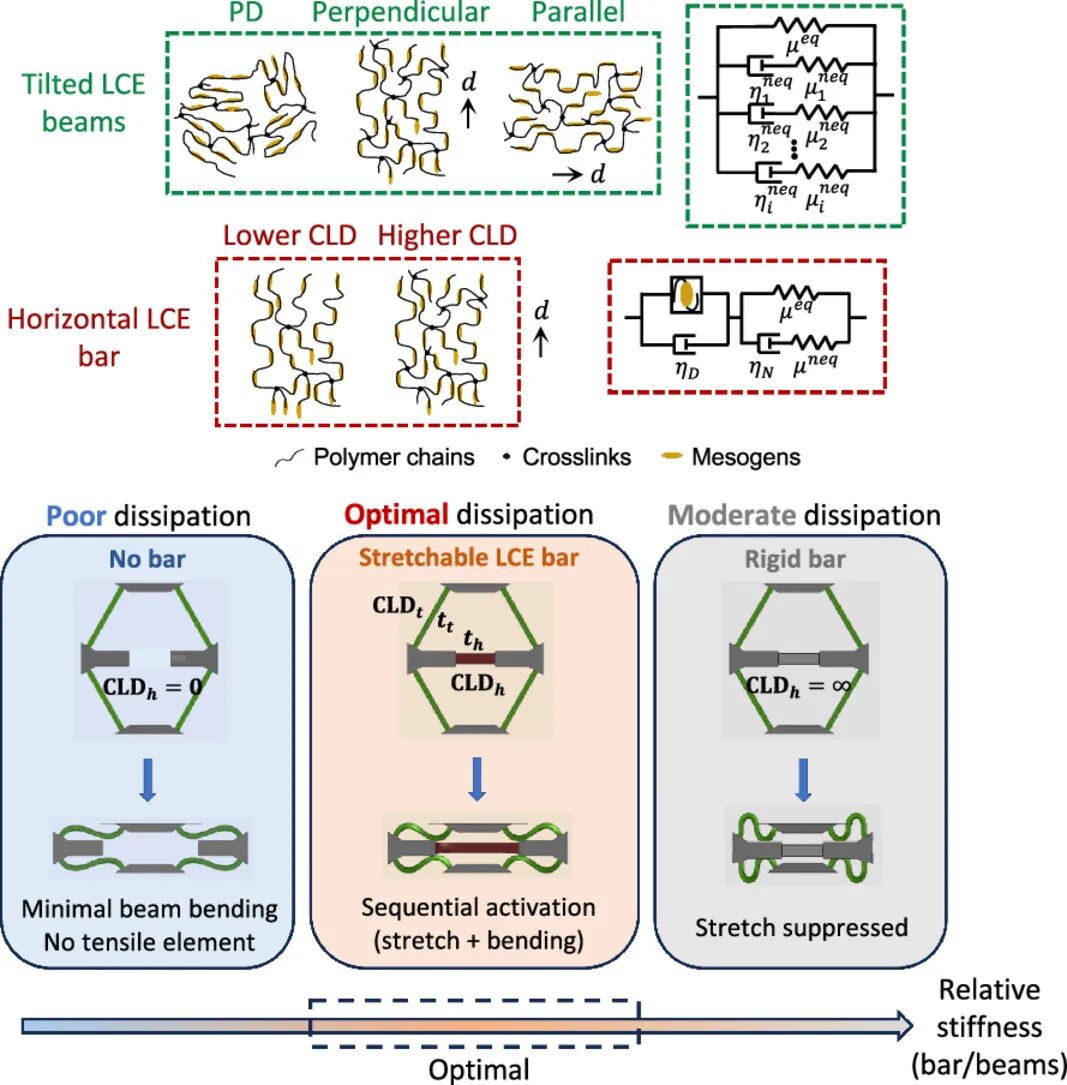
结合拉伸主导和弯曲主导耗散行为优化液晶弹性体晶格结构的能量吸收
Architected materials that exploit buckling to trap energy are effective for impact protection, and their performance can be enhanced by incorporating liquid crystal elastomers (LCEs). Beyond conventional viscoelasticity, LCEs exhibit a highly dissipative, rate-dependent soft stress response in tension associated with mesogen rotation. Because buckling typically occurs at strains below the onset of this soft stress behavior, we introduced an LCE horizontal bar into a hexagonal structure composed of tilted LCE beams. Under compression, stretching of the horizontal bar reduces the angle of the tilted beams and suppresses buckling; however, the viscoelastic softening behavior of LCEs creates the opportunity to design geometries that activate both the buckling of the tilted beams and the large stretching of the horizontal bar. In this work, we characterized the rate-dependent uniaxial tensile response of two monodomain LCE materials with different crosslinking densities and used these data to parameterize a nonlinear viscoelastic model for monodomain LCEs implemented in Abaqus/Standard as a user-defined element. Finite element simulations of the compression response of the hexagonal structure showed that energy absorption is maximized at an optimal thickness ratio between the horizontal bar and the tilted beams, which shifts with the relative modu li of the two structural components. This optimized configuration allows the beams to buckle before substantial stretching develops in the bar and absorbs up to 2.5 times the energy of a rigid-bar counterpart, depending on the effective strain rate and material pairing. The same optimized thickness ratio applies to lattices composed of stacked unit cells, which undergo sequential buckling and lateral stretching across adjacent layers. These interactions create local load–unload–reload cycles that increase per-layer dissipation with increasing number of layers and become more pronounced under repeated loading. Together, these results demonstrate that LCE-based lattice structures can be designed to hierarchically nest competing dissipation mechanis ms across unit-cell and lattice length scales, providing a new strategy for optimizing energy absorption.
利用屈曲来捕获能量的结构材料可以有效地保护碰撞,并且可以通过加入液晶弹性体(LCEs)来增强其性能。除了传统的粘弹性外,LCEs在与介层旋转相关的张力中表现出高度耗散、速率相关的软应力响应。由于屈曲通常发生在低于这种软应力行为开始的应变下,因此我们在倾斜LCE梁组成的六边形结构中引入了LCE水平杆。受压时,水平杆的拉伸减小了倾斜梁的角度,抑制了屈曲;然而,lce的粘弹性软化行为为设计几何形状创造了机会,既可以激活倾斜梁的屈曲,也可以激活水平杆的大拉伸。在这项工作中,我们表征了两种具有不同交联密度的单畴LCE材料的速率相关单轴拉伸响应,并使用这些数据来参数化在Abaqus/Standard中实现的单畴LCE的非线性粘弹性模型作为用户自定义单元。对六角形结构压缩响应的有限元模拟表明,当水平杆与倾斜梁之间的最佳厚度比时,能量吸收最大,该厚度比随两个结构构件的相对模量而变化。根据有效应变率和材料配对的不同,这种优化的结构允许梁在杆内产生大量拉伸之前弯曲,吸收的能量是刚性杆的2.5倍。同样的优化厚度比也适用于由堆叠的单元格组成的晶格,这些晶格在相邻层之间经历了顺序的屈曲和横向拉伸。这些相互作用产生了局部加载-卸载-重新加载循环,随着层数的增加,每层耗散增加,并且在重复加载下变得更加明显。总之,这些结果表明,基于lce的晶格结构可以设计成跨单元格和晶格长度尺度分层嵌套竞争耗散机制,为优化能量吸收提供了一种新的策略。
Thin-Walled Structures
Modelling residual compressive strength of carbon fiber reinforced polymer composites after lightning strike considering nonlinear mechanical degradation
Yuchen Zhou, Kunkun Fu, Huixin Zhu, Bin Yang, Zhenlin Zhang, Xiaoshan Liu, Yan Li
doi:10.1016/j.tws.2025.114475
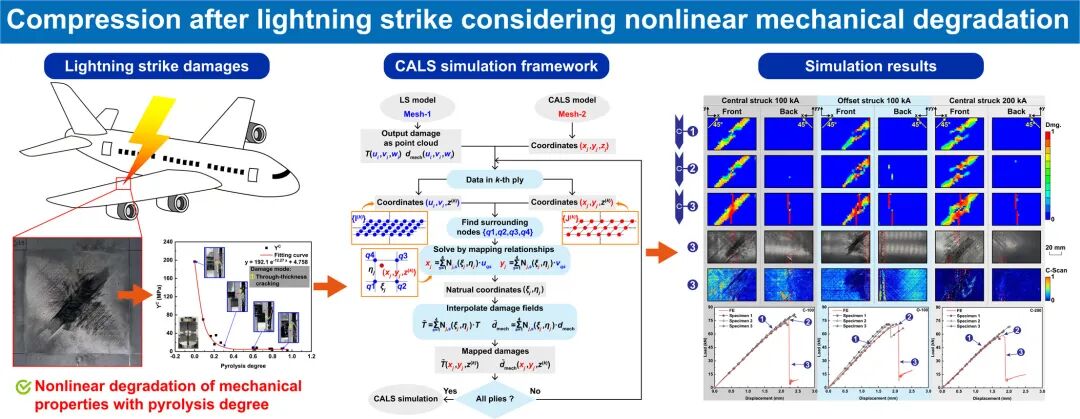
考虑非线性力学退化的碳纤维增强聚合物复合材料雷击后残余抗压强度建模
The residual compressive strength of carbon fiber reinforced polymer (CFRP) composites after lightning strike (LS) is a critical indicator of structural integrity in structure design of aircraft. This study presents a novel modeling approach for predicting the residual compressive strength of CFRP composites after LS, accounting for nonlinear mechanical degradation of damaged region due to LS-induced resin pyrolysis. First, the relationship between the pyrolysis degree of the composites and the degradation of mechanical properties was established experimentally. Subsequently, a finite element (FE) model incorporating nonlinear pyrolysis-dependent thermal damage variables and mechanical damage variables was developed to simulate the residual compressive behavior of CFRP composites. FE results in terms of LS damage area, damage depth, and residual compressive strength showed good agreement with experimental data obtained from artificial LS tests and compression-after-lightning-strike (CALS) experiments, confirming the validity of the proposed FE model. Furthermore, the influence of lightning attachment location on CALS strength was investigated. Results indicated a 31.2% reduction in residual strength when the lightning struck the center of composite specimens compared to theoretical compression strength of undamaged laminate. In contrast, when the lightning attachment point was offset by 37.5 mm from the center, the CALS strength decreased to 234.78 MPa, representing a 37.8% reduction compared to undamaged laminate. Finally, a comparative assess ment with two traditional residual strength prediction methods highlighted the improved accuracy of the proposed FE model in estimating CALS strength.
碳纤维增强聚合物(CFRP)复合材料在雷击后的残余抗压强度是飞机结构设计中衡量结构完整性的重要指标。本研究提出了一种新的模型方法来预测LS后CFRP复合材料的残余抗压强度,该方法考虑了LS诱导的树脂热解引起的损伤区域的非线性力学降解。首先,通过实验建立了复合材料热解程度与力学性能退化的关系。随后,建立了包含非线性热解相关热损伤变量和力学损伤变量的有限元模型来模拟CFRP复合材料的残余压缩行为。在LS损伤面积、损伤深度和残余抗压强度方面的有限元计算结果与人工LS试验和雷击后压缩(CALS)试验数据吻合较好,验证了所建有限元模型的有效性。此外,还研究了闪电附着位置对CALS强度的影响。结果表明,与未损伤层合板的理论抗压强度相比,雷击中心时复合材料的残余强度降低了31.2%。相比之下,当闪电附着点从中心偏移37.5 mm时,CALS强度下降到234.78 MPa,与未损坏的层压板相比降低了37.8%。最后,通过与两种传统残余强度预测方法的对比评估,表明本文提出的有限元模型在估计CALS强度方面的准确性有所提高。
A novel nested hollow-walled lattice mechanical metamaterial combining strut and thin wall with advanced stress stability and energy absorption performance
Jiawen Li, Wei Yu, Peng Wang, Mai Zhang, Yu Bai, Hai Hao
doi:10.1016/j.tws.2026.114477
一种新型嵌套空心壁点阵机械超材料,结合支柱和薄壁,具有优异的应力稳定性和吸能性能
In the design of lightweight mechanical metamaterials (MMs), breaking the trade-off between a high stress level and a stable stress response is still a challenge. To address this challenge, this work proposed a novel nested hollow-walled lattice (NHL) structural system based on the distinct stress response characteristics of different structural elements. This structural system combines thin walls and nested strut-based unit cells with classical lattice structures. By varying the structure of the nested unit cells, the mechanical performance of the NHL can be effectively tailored. In addition, a hollow-walled lattice (HL) structure without nested unit cells was designed for contrast. All samples were fabricated from AlSi10Mg alloy powder via selective laser melting. A combined experimental and finite element simulation method was conducted to investigate the quasi-static mechanical properties, deformation modes, and energy absorption capacity of NHLs. The results demonstrate that NHLs exhibit a more stable stress response and a higher stress level than HL, achieving a specific energy absorption of 32.13 J/g, which is comparable to MMs fabricated by 316L stainless steel. Overall, the proposed structural system achieves excellent structural efficiency through the integration of two structural elements and the nested design. This design strategy demonstrates strong potential for lightweight engineering applications requiring high energy absorption performance.
在轻量化机械超材料(mm)的设计中,打破高应力水平和稳定应力响应之间的权衡仍然是一个挑战。为了解决这一挑战,本研究提出了一种基于不同结构单元不同应力响应特征的新型嵌套空心壁晶格(NHL)结构体系。这个结构系统结合了薄壁和嵌套的基于支柱的单元格与经典的晶格结构。通过改变嵌套单元格的结构,可以有效地定制NHL的机械性能。此外,为了对比,设计了一个没有嵌套单元格的空心壁晶格(HL)结构。所有样品均由AlSi10Mg合金粉末通过选择性激光熔化制备。采用实验与有限元模拟相结合的方法研究了NHLs的准静态力学性能、变形模式和能量吸收能力。结果表明,与HL相比,NHLs具有更稳定的应力响应和更高的应力水平,比能量吸收为32.13 J/g,与316L不锈钢制造的mm相当。总体而言,本文提出的结构体系通过两种结构元素的融合和嵌套设计,达到了优异的结构效率。这种设计策略在需要高能量吸收性能的轻量化工程应用中显示出强大的潜力。
Post-fire mechanical behaviour of stainless steels and membrane residual stresses in laser-welded stainless steel I-sections
Shuai Li, Fangying Wang, Ziyi Wang, Ou Zhao
doi:10.1016/j.tws.2026.114476
火后不锈钢的力学行为和激光焊接不锈钢i型截面的膜残余应力
Laser welding, characterised by high precision and low heat input, is increasingly used in fabricating stainless steel structural members. This paper presents an experimental investigation into the post-fire mechanical behaviour of stainless steels and membrane residual stresses in laser-welded stainless steel I-sections. The testing programme included heating, soaking and cooling of coupon specimens and laser-welded stainless steel I-section specimens as well as post-fire tensile coupon tests and membrane residual stress measurements, with exposure temperatures ranging from 30 °C to 1000 °C. An exposure of grade EN 1.4301 austenitic stainless steels to elevated temperatures showed minimum effects on the Young’s modulus, obvious deteriorations in the 0.2% proof strength and ultimate strength, but pronounced increases in the ultimate strain and fracture strain. Based on the coupon test results, a new set of multi-linear retention factor curves was developed and provided accurate predictions of the post-fire material properties. For post-fire membrane residual stresses, the transition regions (where tensile membrane residual stresses were changed to compressive membrane residual stresses) in the distribution patterns became narrower and the peak values and the discrepancy of tensile and compressive membrane residual stresses were reduced, due to the pronounced redistribution and relaxation of elastic strains throughout cross-sections during heating. Finally, a new series of membrane residual stress predictive models was specifically developed for laser-welded stainless steel I-sections after exposure to elevated temperatures and shown to well represent the measured membrane residual stress distribution patterns and amplitudes over the full temperature range from 30 °C to 1000 °C.
激光焊接以其高精度、低热量输入的特点,越来越多地应用于不锈钢构件的制造。本文对不锈钢火后力学行为和激光焊接不锈钢工字钢的残余应力进行了实验研究。试验程序包括加热、浸泡和冷却试样和激光焊接的不锈钢i型截面试样,以及火灾后拉伸试样和膜残余应力测量,暴露温度范围从30°C到1000°C。EN 1.4301奥氏体不锈钢暴露在高温下,对杨氏模量的影响最小,0.2%的强度和极限强度明显下降,但极限应变和断裂应变明显增加。在试验结果的基础上,建立了一套新的多线性保留系数曲线,并提供了火灾后材料性能的准确预测。对于火灾后的膜残余应力,由于加热过程中弹性应变在整个截面上的重分布和松弛,膜残余应力分布模式中的过渡区域(由拉伸膜残余应力转变为压缩膜残余应力)变窄,拉伸膜和压缩膜残余应力的峰值和差异减小。最后,针对高温下激光焊接不锈钢i型截面,开发了一系列新的膜残余应力预测模型,并证明该模型能够很好地代表在30°C至1000°C的整个温度范围内测量到的膜残余应力分布模式和振幅。