首页/文章/ 详情

【新文速递】2025年10月11日复合材料SCI期刊最新文章
10月前浏览540


今日更新:Composite Structures 1 篇,Composites Part A: Applied Science and Manufacturing 3 篇,Composites Science and Technology 2 篇

Composite Structures

Progressive damage an alysis around in-plane fiber waviness in CFRTP laminates under tensile and compressive loading

Takayu Nishioka, Ryo Higuchi, Tomohiro Yokozeki

doi:10.1016/j.compstruct.2025.119728

拉伸和压缩载荷作用下CFRTP层合板面内纤维波纹的渐进损伤分析

This study proposes a high-fidelity numerical a nalysis method that considers both fiber-dominated and matrix-dominated damage to predict the influence of in-plane fiber waviness on the surface of carbon fiber reinforced thermoplastic (CFRTP) laminates on their mechanical properties. Fiber waviness, a typical manufacturing defect in CFRTP, degrades the mechanical properties and complicates the damage behavior. Even under longitudinal loading, inhomogeneous multi-axial stresses developed around the in-plane fiber waviness, leading to splitting, which is classified as a matrix-dominated damage mode. However, the mechanis m underlying the damage propagation has not yet been fully elucidated. In this study, the fiber- and matrix-dominated damage modes were modeled separately, enabling a more detailed and comprehensive progressive damage an alysis considering the interaction of each damage mode up to the final fracture. The proposed method was validated by comparing the results of the compressive and tensile strength a nalysis with the experimental data. Furthermore, the effects of fiber waviness on the damage mechanis ms were investigated. Fiber-dominated damage was predominant when the severity of the fiber waviness was low, whereas matrix-dominated damage became more significant as the severity of the fiber waviness increases

本文提出了一种同时考虑纤维主导和基体主导损伤的高保真数值分析方法,以预测碳纤维增强热塑性塑料(CFRTP)层合板表面纤维面内波纹度对其力学性能的影响。纤维波纹是碳纤维复合材料的典型制造缺陷,它降低了碳纤维复合材料的力学性能,使其损伤行为复杂化。即使在纵向载荷作用下,纤维面内波纹周围也会产生不均匀的多轴应力,导致劈裂,属于基体主导的损伤模式。然而,损伤传播的机制尚未完全阐明。在这项研究中,纤维和基质主导的损伤模式分别建模,考虑到每种损伤模式的相互作用,从而实现更详细和全面的渐进损伤分析,直到最终破裂。通过将抗压和抗拉强度分析结果与试验数据进行对比,验证了所提方法的有效性。此外,还研究了纤维波纹度对损伤机理的影响。当纤维波纹度较低时,以纤维为主的损伤为主,而随着纤维波纹度的增加,基质为主的损伤更为显著


Composites Part A: Applied Science and Manufacturing

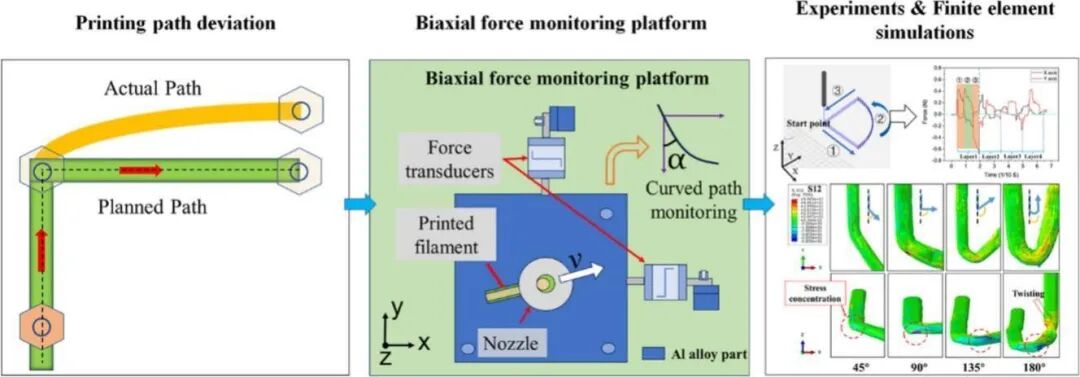
Investigation of path deviation on 3D printing of continuous plant fiber-reinforced composites during turning

Yu Long, Junming Zhang, Yongguang Guo, Zhongsen Zhang, Kunkun Fu, Yan Li

doi:10.1016/j.compositesa.2025.109326
 

连续植物纤维增强复合材料3D打印车削过程路径偏差研究

The advancement of 3D printing technology has expanded the design flexibility for continuous plant fiber-reinforced composites (CPFRCs). However, the deformation of the fiber bundle under pressure and temperature can cause deposited path deviation, leading to reduced dimensional accuracy and mechanical properties. The twisted structure of plant fiber yarns further complicates this issue. This study proposes an in situ biaxial process force measurement method, employing a custom biaxial force monitoring platform to track the dynamic traction forces of CPFRC filaments in real-time, thereby clarifying their formation mechanis ms. The effect of processing factors and geometric path on traction forces was comprehensively examined. The an alysis indicates that the path deviation primarily results from inter-filament extrusion or the abrupt surges in traction force during turning. Based on the established filament turning process model and simulation an alysis, it is found that when the turning angle exceeds 90°, stress concentration induces filament slippage or delamination, resulting in deviation from the planned path. The simulation data align with the experimental results. The elucidation of the mechanis m and influencing factors of printing path deviation provides a foundation for the optimization of the 3D printing process of high-precision and high-strength CPFRCs.

3D打印技术的进步扩大了连续植物纤维增强复合材料(CPFRCs)的设计灵活性。然而,纤维束在压力和温度下的变形会导致沉积路径偏差,导致尺寸精度和力学性能降低。植物纤维纱线的扭曲结构使这一问题进一步复杂化。本研究提出了一种原位双轴过程力测量方法,利用定制的双轴力监测平台实时跟踪CPFRC细丝的动态牵引力,从而阐明其形成机制。综合考察了加工因素和几何路径对牵引力的影响。分析表明,轨迹偏差主要是由于丝间挤压或车削过程中牵引力的突然波动造成的。基于所建立的长丝车削过程模型和仿真分析发现,当车削角度超过90°时,应力集中引起长丝滑移或分层,导致长丝偏离规划路径。仿真数据与实验结果吻合。阐明了打印路径偏差的机理及影响因素,为高精度高强CPFRCs 3D打印工艺的优化提供了基础。


Photogrammetry-enhanced lock-in thermography: A new method for in-situ defects detection and classification in metal-composite hybrid structures

Shan ul Haq, Haris Ali Khan, Hafiz Qasim Ali, Zahid Ahmad Qureshi, Syed Saad Javaid

doi:10.1016/j.compositesa.2025.109349

摄影测量增强锁相热成像:一种金属复合材料混杂结构缺陷原位检测与分类的新方法

This study presents a photogrammetry-based Lock-In Thermography (LIT) methodology for defect classification and sizing in hybrid metal-composite structures, aligning with advancements in microstructural characterization and experimental mechanics. The proposed framework leverages thermal image acquisition via LIT, integrated with a post-processing algorithm that performs sequential pixel-intensity extraction, image reconstruction, and thermal anomaly ana lysis, thereby enhancing the accuracy of defect detection. The methodology was validated on Carbon Fiber Reinforced Polymer (CFRP) samples containing two predefined defects: delamination and debonding. The pixel-intensity distribution an alysis successfully differentiated between the defects, with debonding regions exhibiting higher intensities (105–10⁶) compared to delamination zones (∼104). To assess the robustness of the approach, the framework was extended to an aluminum-CFRP aircraft panel, identifying indentation defects in aluminum and delamination and debonding in CFRP layers, where indentation defects exhibited lower intensity values. The methodology was further applied to an Al/CFRP hybrid joint under tensile loading, where in-situ thermal imaging captured damage progression in real time. The post-processing framework effectively classified damage stages and provided insights into damage propagation mechanis ms. Validation through numerical simulations showed strong agreement with experimental results, confirming the reliability of the approach. The findings offer a novel, non-destructive evaluation (NDE) technique, integrating experimental mechanics, microstructural characterization, and real-time damage tracking for enhanced defect ana lysis in multifunctional composite systems.

本研究提出了一种基于摄影测量的锁定热成像(LIT)方法,用于混杂金属复合材料结构的缺陷分类和尺寸确定,与微结构表征和实验力学的进展相一致。所提出的框架利用通过LIT获取热图像,并结合后处理算法进行顺序像素强度提取、图像重建和热异常分析,从而提高缺陷检测的准确性。该方法在含有两种预定缺陷的碳纤维增强聚合物(CFRP)样品上进行了验证:分层和脱粘。像素强度分布分析成功地区分了缺陷,与分层区(~ 104)相比,脱粘区表现出更高的强度(105-10 26)。为了评估该方法的稳健性,将框架扩展到铝-CFRP飞机面板,识别铝中的压痕缺陷和CFRP层中的分层和脱粘,其中压痕缺陷表现出较低的强度值。该方法进一步应用于拉伸载荷下的Al/CFRP混合接头,现场热成像实时捕获了损伤进展。后处理框架有效地对损伤阶段进行了分类,并提供了对损伤传播机制的见解。数值模拟结果与实验结果吻合较好,验证了该方法的可靠性。该研究结果提供了一种新的非破坏性评估(NDE)技术,将实验力学、微观结构表征和实时损伤跟踪结合起来,用于增强多功能复合材料系统的缺陷分析。


Elucidating microstructure evolution at multicomponent Al/metallic interfaces in friction stir processed aluminum matrix composites and its impact on mechanical properties

X.Y. Han, G.Q. Huang, J. Xu, Z.H. Wang, Z.Y. Cui, J.H. Zheng, X.M. Feng, Y.F. Shen

doi:10.1016/j.compositesa.2025.109350

探讨搅拌摩擦加工铝基复合材料中多组分Al/金属界面的微观结构演变及其对力学性能的影响

The transition from single-element metallic particles to multi-principal element alloy (MPEA) reinforcements significantly enhances the strength and toughness of aluminum matrix composites (AMCs). However, how increasing interfacial chemical complexity affects Al/metallic (Al/M) interfacial evolution and mechanical properties is poorly understood. In this work, AMCs reinforced with pure Ni, NiCoCr medium-entropy alloy (MEA), and FeCoCrNiMn high-entropy alloy (HEA) particles were fabricated via solid-state friction stir processing. Results reveal that the multi-element synergy in MPEA particles suppresses the growth of interfacial diffusion layers due to sluggish diffusion induced by severe lattice distortion. Furthermore, interfacial products evolve from brittle Al3Ni intermetallic compound at the Al/Ni interface to multicomponent body-centered cubic solid solutions at Al/MPEA interfaces, driven by enhanced configurational entropy. This optimized interface enables more efficient stress/strain transfer, leading to progressively improved tensile properties from Ni- to MEA- to HEA-AMCs. This work highlights the critical role of Al/M interfacial chemistry and demonstrates the superior potential of MPEA reinforcements in advancing AMC performance.

单元素金属颗粒增强向多主元素合金增强的转变显著提高了铝基复合材料的强度和韧性。然而,界面化学复杂性的增加对Al/M界面演化和力学性能的影响尚不清楚。采用固体搅拌摩擦法制备了纯Ni、NiCoCr中熵合金(MEA)和fecocnimn高熵合金(HEA)颗粒增强的AMCs。结果表明,MPEA颗粒中的多元素协同作用抑制了界面扩散层的生长,这是由于严重的晶格畸变导致扩散缓慢所致。此外,在构型熵增强的驱动下,界面产物从Al/Ni界面的脆性Al3Ni金属间化合物演变为Al/MPEA界面的多组分体心立方固溶体。这种优化的界面可以实现更有效的应力/应变传递,从而从Ni-到MEA-再到hea - amc逐步提高拉伸性能。这项工作强调了Al/M界面化学的关键作用,并证明了MPEA增强剂在提高AMC性能方面的卓越潜力。


Composites Science and Technology

Mechanically strong and environmentally stable MXene films reinforced by CNT-embedded aramid nanofibers for electromagnetic interference shielding

Shanshan Chen, Jianbin Chen, Zhaoqing Lu, Rui Cheng, Li Hua, Dinggen Hu, Wenbo Wang, Nana Wang, Zhijian Li

doi:10.1016/j.compscitech.2025.111408
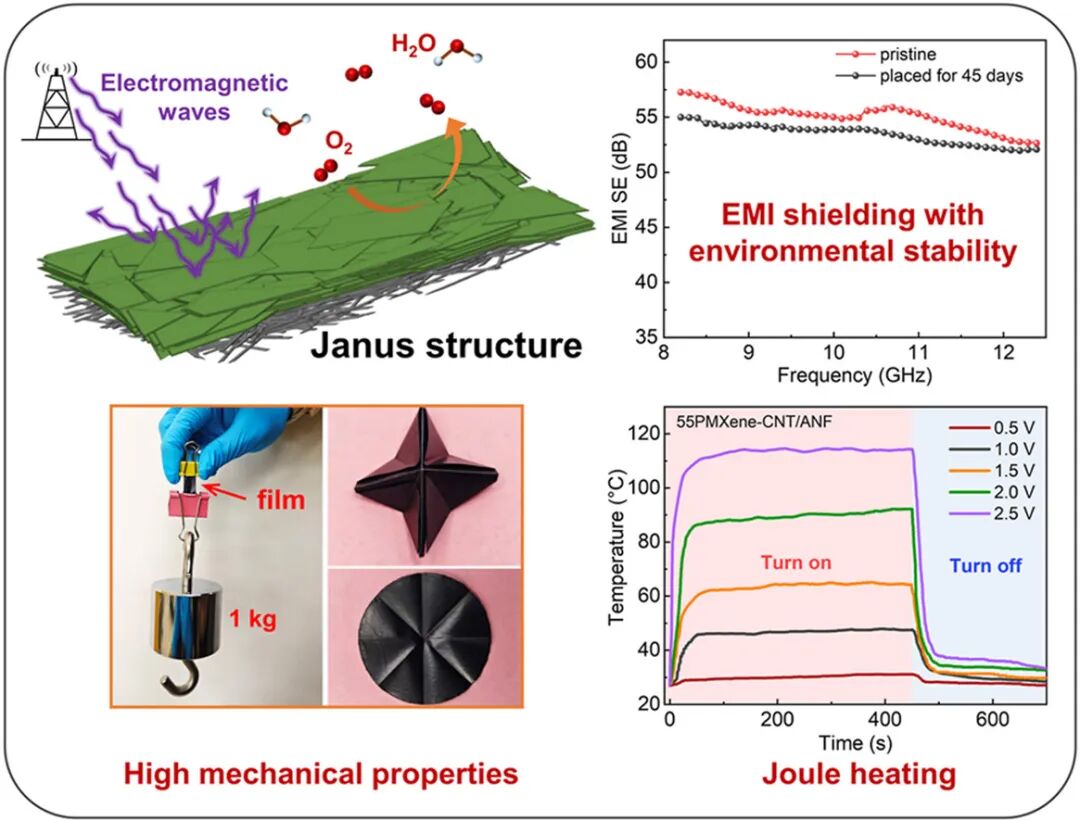
 

机械强度和环境稳定的MXene薄膜由碳纳米管嵌入芳纶纳米纤维增强,用于电磁干扰屏蔽

Developing novel transition metal carbides/nitrides (MXene)-based electromagnetic interference (EMI) shielding composites with excellent mechanical properties and oxidation resistance is urgently demanded but remains hugely challenging thanks to the increasingly sophisticated application scenarios. Herein, we demonstrated an interfacial engineering and sequential assembling strategy to synergistically address the above problems. Carbon nanotubes (CNT) were utilized to assist the splitting preparation of aramid nanofibers (ANF) and chemical cross-linking to construct a substrate layer that served to provide mechanical properties. Polydopamine (PDA) was modified onto MXene surface (PMXene) by in situ polymerization and binding, generating an adhesive layer to prevent oxygen penetration effectively. The resultant Janus-structured PMXene-CNT/ANF films exhibited outstanding mechanical performances including high tensile strength (366.8 MPa) and toughness (69.3 MJ m−3), superb electrical conductivity (3548.8 S cm−1), impressive EMI shielding effectiveness (EMI SE 55.5 dB) and EMI SE/t (14128.2 dB cm−1), as well as excellent oxidation stability. Furthermore, the flexible films displayed distinguished Joule-heating performances and fast and sensitive temperature response at external voltage. Therefore, such composite films with excellent mechanical properties and environmental stability have great practical value in flexible electronics and military electronic equipment for EMI shielding, and the polar-exploration equipment for anti-icing and de-icing.

开发具有优异机械性能和抗氧化性能的新型过渡金属碳化物/氮化物(MXene)基电磁干扰(EMI)屏蔽复合材料是迫切需要的,但由于应用场景日益复杂,仍然具有巨大的挑战性。在此,我们展示了一种界面工程和顺序组装策略来协同解决上述问题。碳纳米管(CNT)被用于辅助芳纶纳米纤维(ANF)的分裂制备和化学交联,以构建提供机械性能的衬底层。通过原位聚合和结合将聚多巴胺(PDA)修饰在MXene表面(PMXene)上,形成一层有效阻止氧渗透的粘附层。所得到的janus结构PMXene-CNT/ANF薄膜具有出色的机械性能,包括高拉伸强度(366.8 MPa)和韧性(69.3 MJ m−3),卓越的导电性(3548.8 S cm−1),令人印象深刻的EMI屏蔽效果(EMI SE 55.5 dB)和EMI SE/t (14128.2 dB cm−1),以及出色的氧化稳定性。此外,柔性薄膜具有优异的焦耳加热性能和快速灵敏的外部电压温度响应。因此,这种具有优异力学性能和环境稳定性的复合薄膜在柔性电子和军用电子设备中屏蔽电磁干扰、极地探测设备防冰除冰等方面具有很大的实用价值。


Development of lightweight liquid metal/elastomer-based composite foams for high-performance electromagnetic interference shielding through a chemical upcycling strategy of recycled poly(ethylene terephthalate)

Chia-Wei Lee, Chia-Hsing Lin, Lyu-Ying Wang, Yi-Huan Lee

doi:10.1016/j.compscitech.2025.111410
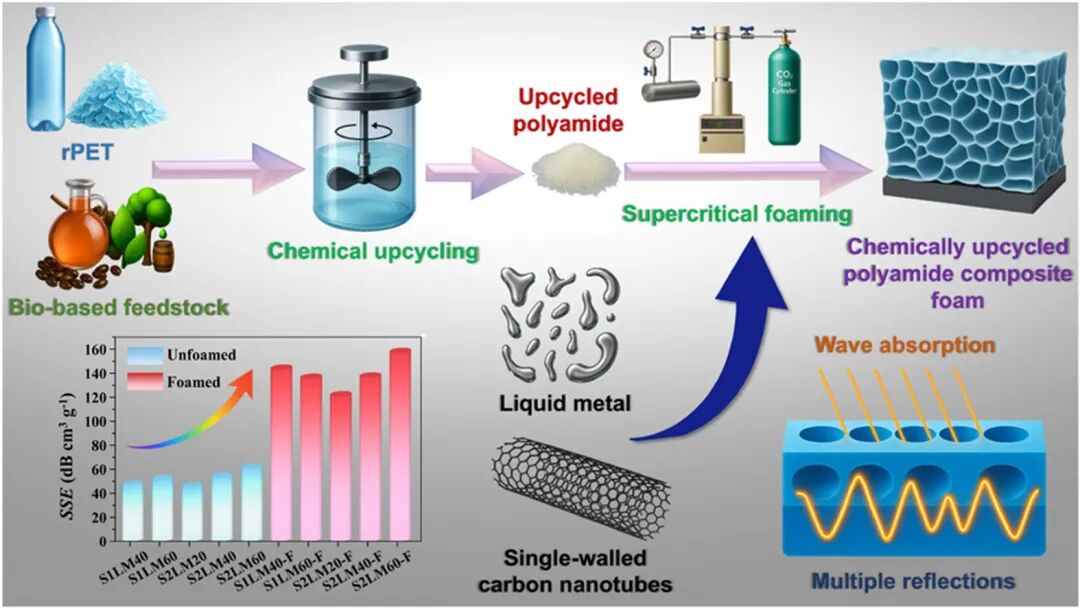
 

利用回收聚对苯二甲酸乙酯化学升级策略开发高性能电磁干扰屏蔽用轻质液态金属/弹性体复合泡沫

Producing high-performance electromagnetic interference (EMI) shielding foams through chemical upcycling of waste plastics is a promising solution for reducing plastic waste and electromagnetic radiation pollution. Here, we successfully integrated chemical upcycling of recycled polyethylene terephthalate (rPET); eutectic gallium–indium (EGaIn) liquid metal (LM); and supercritical carbon dioxide (sc-CO2) foaming to develop an EMI shielding foam system. First, a bis(6-aminohexyl)terephthalamide–adipic acid (BAHT–AA) salt from the aminolysis of rPET was copolymerized with a bio-based 1,10-decanediamine–sebacic acid (DA–SA) salt and polyetheramine to form a polyamide (PA) system. The introduction of BAHT enabled the circular utilization of rPET. Moreover, the benzene of BAHT effectively promoted the PA system’s melt strength, thereby improving its sc-CO2 foaming ability for producing microporous foams. Subsequently, EGaIn and single-walled carbon nanotubes (SWCNTs) were incorporated into the PA system through a cryogenic freezing–mechanical grinding hybrid strategy. SWCNTs served as synergistic fillers that allowed the formation of SWCNT/EGaIn networks within the PA; thus, the produced composites could be used to manufacture conductive foams for EMI shielding. Under the optimized addition of 2 wt% SWCNTs and 60 wt% LM, the conductivity and specific shielding effectiveness (SSE) of the system reached excellent levels of 1.8 × 10³ S/cm and 157 dB cm3 g-1, respectively. Moreover, the composite foam system possessed high durability and favorable heat dissipation. It not only maintained its shielding performance after multiple bending or twisting cycles but also mitigated heat accumulation. This research represents a breakthrough in the development of sustainable, advanced EMI shielding systems.

通过废旧塑料的化学升级回收生产高性能电磁干扰(EMI)屏蔽泡沫是减少塑料废物和电磁辐射污染的一种很有前途的解决方案。在这里,我们成功地整合了回收的聚对苯二甲酸乙二醇酯(rPET)的化学升级;共晶镓铟液态金属(LM);超临界二氧化碳(sc-CO2)发泡,开发电磁干扰屏蔽泡沫系统。首先,将rPET氨解所得的双(6-氨基己基)对苯二甲酸(BAHT-AA)盐与生物基1,10-癸二酸(DA-SA)盐和聚醚胺共聚形成聚酰胺(PA)体系。泰铢的引入使rPET的循环利用成为可能。此外,BAHT中的苯有效地提高了PA体系的熔体强度,从而提高了其sc-CO2发泡能力,用于生产微孔泡沫。随后,通过低温冷冻-机械磨削混合策略将EGaIn和单壁碳纳米管(SWCNTs)纳入到PA系统中。SWCNTs作为协同填料,允许在PA内形成SWCNTs /EGaIn网络;因此,所制备的复合材料可用于制造电磁干扰屏蔽的导电泡沫。在SWCNTs添加量为2 wt%和LM添加量为60 wt%的优化条件下,体系的电导率和比屏蔽效率(SSE)分别达到1.8 × 10³ S/cm和157 dB cm3 g-1的优异水平。此外,复合泡沫体系具有较高的耐久性和良好的散热性。它不仅在多次弯曲或扭转循环后保持其屏蔽性能,而且减轻了热量的积累。这项研究代表了可持续发展的先进电磁干扰屏蔽系统的突破。 
来源:复合材料力学仿真Composites FEM
ACTMechanicalSystemMAGNETDeform复合材料化学电子材料试验
著作权归作者所有,欢迎分享,未经许可,不得转载
首次发布时间:2025-10-17
最近编辑:10月前
Tansu
签名征集中
获赞 22粉丝 6文章 1031课程 0
点赞
收藏
作者推荐

【新文速递】2025年9月14日复合材料SCI期刊最新文章

今日更新:Composite Structures 4 篇,Composites Part A: Applied Science and Manufacturing 4 篇,Composites Part B: Engineering 1 篇Composite StructuresEfficient derivation of a nonlinear cohesive bridging law for numerical delamination simulations under static and fatigue loadingG. Hacker, G. Just, S. Scheffler, I. Koch, M. Gude, R. Rolfesdoi:10.1016/j.compstruct.2025.119585静态和疲劳载荷下数值分层模拟非线性黏结桥接规律的有效推导Delamination is a frequent and critical type of damage that occurs in composite structures under static and fatigue loading. This work presents a novel method to derive a nonlinear traction-separation law (TSL) for a cohesive zone model (CZM) used for delamination simulations is presented. By solving an ordinary differential equation (ODE) resulting from the energy balance of the cohesive zone, a nonlinear TSL is directly derived from R-curves that were determined experimentally in standard quasi-static double cantilever beam (DCB) tests. A superimposed conventional bilinear TSL is required to match the initial energy release rate of the R-curves. This bilinear TSL is intended to model brittle fracture while the nonlinear part models the R-curve effects mainly caused by fiber bridging. In order to consider R-curve effects under fatigue loading conditions as well, an established fatigue CZM is embedded into both parts of the TSL using the same set of four required input parameters. The fatigue parameters are determined inversely by means of cyclic DCB tests. It is demonstrated that the numerical model is able to reproduce the force–displacement curves of the conducted quasi-static DCB tests with a higher accuracy, if the TSL is derived by the new method instead of the preexisting and commonly used J-integral approach. Furthermore, the model is able to reproduce experimental data from conducted cyclic DCB test with a limited number of input parameters which significantly decreases the effort of inverse parameter identification.分层是复合材料结构在静载荷和疲劳载荷作用下发生的一种常见且关键的损伤类型。本文提出了一种新的方法来推导用于分层模拟的内聚带模型(CZM)的非线性牵引-分离律(TSL)。通过求解由内聚区能量平衡引起的常微分方程(ODE),直接从标准准静态双悬臂梁(DCB)试验中得到的r曲线推导出非线性TSL。需要一个叠加的传统双线性TSL来匹配r曲线的初始能量释放率。双线性TSL用于模拟脆性断裂,非线性部分模拟主要由纤维桥接引起的r曲线效应。为了考虑疲劳载荷条件下的r曲线效应,将一个已建立的疲劳CZM嵌入到TSL的两个部分,使用相同的4个所需输入参数。通过循环DCB试验反求疲劳参数。结果表明,如果采用新方法代替现有常用的j积分法推导TSL,则该数值模型能够以更高的精度再现所进行的准静态DCB试验的力-位移曲线。此外,该模型能够在有限输入参数的情况下再现循环DCB试验的实验数据,大大减少了参数逆辨识的工作量。Simple ana lytical modeling of residual flexural properties of hybrid PEEK thermoplastic composite laminate under kerosene flame exposureLanhui Lin, Benoit Vieille, Christophe Bouvet, Tanguy Davindoi:10.1016/j.compstruct.2025.119648煤油火焰下混杂PEEK热塑性复合材料层合板残余弯曲性能的简单解析建模The present work aims to propose a simple two-layer ana lytical model to determine the residual bending properties of hybrid carbon/glass fibers reinforced PEEK (CG/PEEK) laminates under localized kerosene flame exposure (1100 °C and 116 kW/m2 by a burner bench). It is intended to better understand the relationship between thermally-induced damages and the residual bending properties and also to predict the changes of the flexural properties as a function of flame exposure time. On the one hand, the influence of porosity induced by isothermal heating conditions (temperature ranging from the melting one to the point of resin decomposition) on post-heat flexural properties is examined, which allows the effects of different phase transitions of the PEEK matrix to be dissociated. The residual flexural strength and stiffness of thermally degraded laminates decrease rapidly with the increasing amount of porosity as function of exposure temperature and heating time (400 – 450 – 500 – 525 – 550℃ for 300 – 600 – 900 s). These isothermal tests allow master curves to be formulated that show the correlations between porosity ratio and residual flexural properties. These master curves, combined with through-thickness observations, are expected to provide a comprehensive interpretation of the post-fire flexural behavior of different layers. On the other hand, by means of a two-layer (char layer and decomposition layer) model considering different distances from the flame, it is possible to determine the residual bending properties of post-fire CG/PEEK laminates as a function of the flame exposure times. The proposed ana lytical model shows a good agreement with the experimental results (obtained in the preliminary study), and the important role of the char layer and its residual properties under long-time flame exposures are highlighted本工作旨在提出一个简单的两层分析模型,以确定混合碳/玻璃纤维增强PEEK (CG/PEEK)层压板在局部煤油火焰暴露(1100 °C和116 kW/m2燃烧器台)下的残余弯曲性能。旨在更好地理解热致损伤与残余弯曲性能之间的关系,并预测弯曲性能随火焰暴露时间的变化。一方面,研究了等温加热条件(从熔点到树脂分解点的温度范围)引起的孔隙率对热后弯曲性能的影响,从而可以解离PEEK基体不同相变的影响。随着暴露温度和加热时间(400 ~ 450 ~ 500 ~ 525 ~ 550℃,300 ~ 600 ~ 900 s)的增加,热降解层压板的残余抗弯强度和刚度迅速降低。这些等温测试允许制定主曲线,显示孔隙率和残余弯曲性能之间的相关性。这些主曲线与贯穿厚度观测相结合,有望提供不同层的火灾后弯曲行为的综合解释。另一方面,通过考虑到与火焰的不同距离的两层(炭层和分解层)模型,可以确定火灾后CG/PEEK层压板的残余弯曲性能作为火焰暴露时间的函数。所提出的分析模型与实验结果(初步研究结果)吻合良好,并突出了焦炭层及其在长时间火焰照射下的残余性能的重要作用Neural network-assisted design optimization with adaptive sampling for tow-steered composite structuresBangde Liu, Xin Liudoi:10.1016/j.compstruct.2025.119588带自适应采样的神经网络辅助双舵复合结构设计优化Tow-steered composites offer significant potential for enhancing weight reduction and performance in aerospace structures. However, optimizing realistic tow-steered composite designs using finite element (FE)-based methods is often computationally prohibitive due to the expansive design space. Neural network (NN) models have emerged as a cost-effective alternative to FE-based optimization approaches. However, advanced NN models typically require substantial training data to achieve high accuracy, and the generation of this data through FE ana lysis of tow-steered composite structures remains computationally intensive. To address this challenge, this study introduces an adaptive sampling method that effectively reduces the required training data while enhancing the accuracy of NN-based design optimization. The proposed method is demonstrated on two tow-steered composite structures with different numbers of design variables, showcasing its ability to achieve improved optimization accuracy and reduced costs. The proposed method can be applied to other NN-based optimization problems, mitigating computational demands associated with generating training data.牵引复合材料在提高航空结构的减重和性能方面具有巨大的潜力。然而,由于设计空间的扩大,使用基于有限元(FE)的方法优化现实的牵引复合材料设计通常在计算上是令人望而却步的。神经网络(NN)模型已成为基于fe的优化方法的一种经济有效的替代方法。然而,先进的神经网络模型通常需要大量的训练数据才能达到高精度,并且通过对牵引复合结构的有限元分析生成这些数据仍然需要大量的计算。为了解决这一挑战,本研究引入了一种自适应采样方法,该方法有效地减少了所需的训练数据,同时提高了基于神经网络的设计优化的准确性。在两个具有不同设计变量数量的双舵复合结构上进行了验证,证明了该方法能够提高优化精度并降低优化成本。该方法可以应用于其他基于神经网络的优化问题,减少与生成训练数据相关的计算需求。Numerical simulation of three-point bending deformation for 3D woven preforms based on the virtual yarn modeling strategyGeyi You, Junbo Xie, Jiawei Chen, Wei Jiao, Li Chendoi:10.1016/j.compstruct.2025.119652基于虚拟纱线建模策略的三维机织预制件三点弯曲变形数值模拟SiC fiber reinforced ceramic matrix composites are widely used in the aerospace field for their good mechanical properties at high temperature. Deformation of the fiber preforms is however inevitable in the manufacturing process of complex-shaped composite components. The bending behavior plays a crucial role in determining of the preform geometries. This paper proposes a novel modeling strategy to generate yarn structures and simulate bending deformation of SiC fiber 3D woven preforms. Low bending stiffness of the yarn is decoupled from high tension stiffness through the shell/truss hybrid meshes, and the bending stiffness is calibrated by cantilever bending test of SiC fiber yarns. The bending deformation and load–deflection response of SiC fiber 3D woven preform is well predicted using this modeling method. Microstructure deformations including the variations of weft yarn arrangement, and warp yarn path are quantitatively ana lyzed by Euclidean distance-based metric an alysis. The simulation results are verified by three-point bending test of the preform specimen and the Micro-CT scanning of the deformed preform sample. This work provides a yarn-level modeling method which can be widely applied on other textile preforms. The virtual yarn modeling strategy is more efficient than the fiber-level approaches, thus has advantage on simulations of large-sized preforms.SiC纤维增强陶瓷基复合材料以其良好的高温力学性能在航空航天领域得到了广泛的应用。然而,在复杂形状复合材料构件的制造过程中,纤维预成形件的变形是不可避免的。弯曲性能对预成形几何形状的确定起着至关重要的作用。本文提出了一种新的模拟SiC纤维三维机织预制件纱线结构和弯曲变形的建模方法。通过壳/桁架混合网格将纱线的低弯曲刚度与高拉伸刚度解耦,并通过SiC纤维纱线的悬臂弯曲试验对其弯曲刚度进行标定。利用该建模方法可以很好地预测SiC纤维三维编织预制件的弯曲变形和载荷-挠度响应。采用基于欧几里得距离的度量分析方法,定量分析了织物的微结构变形,包括纬纱排列和经纱路径的变化。通过预成形试样的三点弯曲试验和变形后预成形试样的Micro-CT扫描验证了模拟结果。本工作提供了一种纱线级的建模方法,可广泛应用于其他纺织预制品的建模。虚拟纱线建模策略比纤维级建模方法更有效,因此在大型预成型的仿真中具有优势。Composites Part A: Applied Science and ManufacturingImpact of curing profiles on the Thermo-Mechanical properties of an underfill in Board-Level microelectronic Packaging: Effect on reliabilityZbyněk Plachý, Jonáš Uřičář, Denis Froš, Anna Pražanová, Karel Dušek, Attila Géczydoi:10.1016/j.compositesa.2025.109298 固化轮廓对板级微电子封装中底填料热机械性能的影响:对可靠性的影响The paper investigates the effect of isothermal curing profiles, based on detailed kinetic an alysis, on the mechanical, thermomechanical, and microstructural properties of an epoxy composite microelectronic packaging underfill material for enhanced electronics reliability. Five isothermal profiles were developed based on detailed Kamal-Sourour kinetic modelling to achieve near-complete curing. Subsequent characterisation included DSC, tensile tests, DMA, microhardness measurements, and SEM-EDS ana lysis. The results revealed a complex dependence of properties on the curing profile. The 170 °C profile provided the optimal ultimate tensile strength (UTS≈71.5 MPa) and Young’s modulus (5.53 GPa), which correlated with the most homogeneous polymer network as determined by the narrowest glass transition width. Conversely, T g values exhibited a strong inverse relationship with UTS and Young’s modulus, qualified by strong negative Spearman correlations (−1.0 to −0.9). The 150 °C profile resulted in the highest toughness. The microstructural ana lysis confirmed SiO2 filler sedimentation at 110 °C, while profiles at 150–170 °C showed the most uniform filler distribution. The thermal degradation of the material was observed at the 190 °C profile. The study demonstrates that the specific temperature–time profile, not just the achieved degree of cure, critically dictates the underfill’s microstructure and final properties. Identification of the optimal process window, approximately 150–170 °C for this material, is essential for achieving desired performance while minimising defects, a fundamental aspect of reliability in electronic applications. Furthermore, this defined processing window provides the flexibility to adapt curing profiles to the thermal constraints of a component or assembly, helping to mitigate thermomechanical stress during manufacturing.本文在详细的动力学分析的基础上,研究了等温固化轮廓对环氧复合微电子封装底填料力学、热力学和微观结构性能的影响,以提高电子可靠性。基于详细的kamal - sour动力学模型,开发了5条等温曲线,以实现近乎完全的固化。随后的表征包括DSC,拉伸测试,DMA,显微硬度测量和SEM-EDS分析。结果显示,性能的复杂依赖于固化轮廓。170°C的轮廓提供了最佳的极限拉伸强度(UTS≈71.5 MPa)和杨氏模量(5.53 GPa),这与最窄的玻璃化转变宽度决定的最均匀的聚合物网络相关。相反,T g值与UTS和杨氏模量表现出强烈的反比关系,具有强烈的负Spearman相关性(- 1.0至- 0.9)。150°C的轮廓产生了最高的韧性。显微结构分析证实了SiO2填料在110℃时的沉降,而在150 ~ 170℃时的剖面显示填料分布最均匀。在190℃剖面下观察到材料的热降解。研究表明,特定的温度-时间曲线,而不仅仅是达到的固化程度,对下填体的微观结构和最终性能有着关键的影响。确定该材料的最佳工艺窗口(约150-170°C)对于实现所需性能,同时最大限度地减少缺陷至关重要,这是电子应用可靠性的基本方面。此外,这种定义的加工窗口提供了灵活性,使固化轮廓适应组件或组件的热约束,有助于减轻制造过程中的热机械应力。Improved fiber–matrix bonding of continuous aramid fiber reinforced acrylonitrile-styrene-acrylate polymer using in-situ impregnation material extrusion additive manufacturing techniqueNishant Jain, Mathias Czasny, Johannes Schmidt, Sara Alves Santos, David Schmiedjell, Sabine Hild, Aleksander Gurlodoi:10.1016/j.compositesa.2025.109299 利用原位浸渍材料挤压增材制造技术改进了连续芳纶纤维增强丙烯腈-苯乙烯-丙烯酸酯聚合物的纤维-基体粘合This study compares the fiber–matrix bonding of acrylonitrile-styrene-acrylate (ASA) terpolymer reinforced with standard-finish (A1) and adhesion-activated finish (A2) aramid fibers (Twaron®) manufactured using an in-situ additive manufacturing (AM) material extrusion technique. A2 fibers showed a slightly higher total surface energy (γs ∼ 49.45 mN/m) compared to A1 fibers (γs ∼ 44.20 mN/m) indicating potentially higher interfacial interaction of A2 fibers with polymer matrix. For single-line manufactured composites, the fiber–matrix bonding performance of the A2-ASA composite improved significantly on increasing the processing temperature from 240 °C to 300 °C resulting in an increase in ultimate tensile strength (UTS) from 694 MPa to 870 MPa. In contrast, A1-ASA composites showed a reduction in UTS from 674 MPa to 544 MPa over the same temperature. Improved mechanical performance of the composite reinforced with A2 fibers was also observed in the multi-layer manufactured composite, where UTS reached 450 MPa and a Young’s modulus of 33 GPa, compared to 426 MPa and 15 GPa for the standard finish fibers. The flexural properties confirm the observed improvements in the mechanical properties of A2-ASA composite. The observation derived from the experimental results indicates that the properties of the fiber surface are crucial for enhancing the fiber–matrix bonding, particularly during the manufacturing process of continuous fiber-reinforced composites utilising material extrusion AM techniques. This ASA-aramid composite can be further exploited as a high-performance composite with improved weatherability for outdoor applications.本研究比较了使用原位增材制造(AM)材料挤出技术制造的标准表面处理(A1)和粘合活化表面处理(A2)芳纶纤维(Twaron®)增强的丙烯腈-苯乙烯-丙烯酸酯(ASA)三元共聚物的纤维-基体粘合。与A1纤维(γs ~ 44.20 mN/m)相比,A2纤维显示出略高的总表面能(γs ~ 49.45 mN/m),表明A2纤维与聚合物基体的界面相互作用可能更高。对于单线制造的复合材料,当加工温度从240 °C增加到300 °C时,A2-ASA复合材料的纤维-基体结合性能得到显著改善,其极限抗拉强度(UTS)从694 MPa增加到870 MPa。相比之下,在相同温度下,A1-ASA复合材料的UTS从674 MPa降低到544 MPa。与标准整理纤维的426 MPa和15 GPa相比,A2纤维增强的多层复合材料的机械性能也得到了改善,其UTS达到450 MPa,杨氏模量为33 GPa。弯曲性能证实了观察到的A2-ASA复合材料力学性能的改善。实验结果表明,纤维表面的性能对增强纤维与基体的结合至关重要,特别是在利用材料挤压增材制造技术制造连续纤维增强复合材料的过程中。这种asa -芳纶复合材料可以进一步开发为高性能复合材料,改善室外应用的耐候性。Surface modified UHMWPE fibers with functional interfacial layers: a strategy for enhanced composite interfacial and mechanical performanceYan Wang, Xianhui Dong, Na Li, Yan Wang, Yinjun Chen, Junrong Yu, Zuming Hu, Meifang Zhudoi:10.1016/j.compositesa.2025.109300 具有功能界面层的表面改性超高分子量聚乙烯纤维:增强复合界面和机械性能的策略Ultra-high molecular weight polyethylene (UHMWPE) fiber is prized for the superior strength and modulus. Nevertheless, the s moothness of fiber surface and the absence of polar functional groups in polymer backbone result in poor interfacial adhesion with matrix of composites. This severely decreases the mechanical performance and impedes the practical applications of UHMWPE fiber-reinforced composites. To optimize the interfacial compatibility between UHMWPE fiber and matrix, a series of amphipathic polymer brush PVA-OCT oligomer and multi-armed molecule DiPE-OCT with various functional groups herein as interfacial modification agents were synthesized. These functional groups form tight interaction with UHMWPE fiber and matrix through the mechanical interlocking and hydrogen bonding interactions, respectively. After modification by interfacial modification agents, UHMWPE fiber-reinforced composites exhibited a significant enhancement in the interfacial bonding and mechanical properties. Notably, an enhancement of 158.1 % in interfacial shear strength (6.35 MPa) was achieved in modified UHMWPE fiber-reinforced epoxy composites compared to the control composite. Meanwhile, the flexural and tensile strengths of modified composites increased by 107.4 % and 53.3 %, respectively. Consequently, this study provides a facile and innovative method for the surface modification of UHMWPE fiber and remarkably reinforces UHMWPE fiber composites, actuating the industrial application of UHMWPE fiber composites.超高分子量聚乙烯(UHMWPE)纤维因其优越的强度和模量而备受推崇。然而,纤维表面的光滑性和聚合物骨架中极性官能团的缺失导致其与复合材料基体的界面附着力较差。这严重降低了超高分子量聚乙烯纤维增强复合材料的力学性能,阻碍了其实际应用。为了优化UHMWPE纤维与基体的界面相容性,合成了一系列具有不同官能团的两亲聚合物刷式PVA-OCT低聚物和多臂分子DiPE-OCT作为界面改性剂。这些官能团分别通过机械联锁作用和氢键作用与超高分子量聚乙烯纤维和基体形成紧密的相互作用。界面改性剂对UHMWPE纤维增强复合材料进行改性后,其界面结合性能和力学性能均有显著提高。值得注意的是,改性UHMWPE纤维增强环氧复合材料的界面剪切强度(6.35 MPa)比对照复合材料提高了158.1 %。同时,改性复合材料的抗弯强度和抗拉强度分别提高了107.4 %和53.3% %。因此,本研究为超高分子量聚乙烯纤维的表面改性提供了一种简便、创新的方法,显著增强了超高分子量聚乙烯纤维复合材料的性能,推动了超高分子量聚乙烯纤维复合材料的工业化应用。A damage tensor-based model for effective resistivity of CFRP θ1/θ2S laminates with matrix crackingKeiji Ogi, Yuji Ozawa, Ryotaro Ozaki, K. Mizukamidoi:10.1016/j.compositesa.2025.109301 一种基于损伤张量的含基体开裂的 CFRP θ1/θ2S 层合板有效电阻率模型This study presents a continuum damage mechanics (CDM)-inspired model for predicting the effective resistivity of θ1/θ2S CFRP laminates with matrix cracks in the θ2 plies. The laminate-level resistivity is evaluated using the electric-field lamination theory, and an explicit solution for the electric potential in a cracked 90° lamina is derived. This leads to ana lytical expressions for both the damage tensor and effective resistivity as functions of matrix crack density. The proposed model is validated against finite element ana lysis (FEA) and the existing closed-form solution (CFS). Across a wide range of conditions—including strong in-plane and through-thickness anisotropy—the CDM predictions show good agreement with FEA, and outperform the CFS particularly in highly anisotropic regimes. Applicability is demonstrated for both cross-ply and angle-ply laminates, as well as for laminates with three-dimensional anisotropy. Furthermore, a consistent relationship between resistivity change and stiffness degradation is shown, supporting the model’s relevance to electrical health monitoring (EHM) of CFRPs. These results offer a unified, physically grounded framework for evaluating damage-induced resistivity changes in electrically anisotropic composite laminates.本研究提出了一种受连续损伤力学(CDM)启发的模型,用于预测含 θ2 层间基体裂纹的 θ1/θ2S 碳纤维增强复合材料(CFRP)层合板的有效电阻率。采用电场叠层理论评估层合板级电阻率,并推导出含裂纹 90°层板中电位的显式解。由此得出损伤张量和有效电阻率随基体裂纹密度变化的解析表达式。所提出的模型通过有限元分析(FEA)和现有的闭式解(CFS)进行了验证。在包括强面内和层间各向异性在内的广泛条件下,CDM 预测结果与 FEA 结果吻合良好,并且在高度各向异性区域尤其优于 CFS。该模型适用于正交层合板、角向层合板以及具有三维各向异性的层合板。此外,还表明电阻率变化与刚度退化之间存在一致的关系,这支持了该模型在 CFRP 电学健康监测(EHM)中的相关性。这些结果为评估电各向异性复合层压板中由损伤引起的电阻率变化提供了一个统一且有物理依据的框架。Composites Part B: EngineeringConstructing Robust C-N bonding Interphases of Carbon Fiber/Epoxy Composites via the Electrode-switching Electrochemical Surface Treatment of Carbon FibersBing Zhang, Changyu Leng, Maoqun Hu, Xianglin Ma, Mengjiao Xu, Nannan Guo, Lili Ai, Qingtao Ma, Dengtai Yuan, Shishi Zhang, Qian Li, Dianzeng Jia, Luxiang Wangdoi:10.1016/j.composites b.2025.113029 通过碳纤维电极开关电化学表面处理构建碳纤维/环氧复合材料坚固的C-N键界面The interphase formed between carbon fiber (CF) and polymer matrix is crucial to improve the mechanical properties of carbon fiber reinforced polymer (CFRP) composites. Various surface treatment methods have been developed for grafting functionalized molecules on the CF surface to form robust covalent bonding interphase. However, the state-of-the-art strategies demand long reaction time, complex operation and harsh reaction conditions, which cannot meet growing demands for large-scale actual production. Herein, an electrode-switching electrochemical surface treatment (ESET) method was proposed for the efficient and controllable grafting of ethylenediamine (EDA) molecules on the CF surface within merely 180 s. The obtained o-r-CF@EDA was successively used as the anode and cathode for grafting EDA molecules on the surface. It exhibited a high surface N content of 18.74 at.% (with a maximum of 32.04 at.%) and surface energy of 52.61 mN m-1. When combined with epoxy resin (EP) matrix, the average interfacial thickness of o-r-CF@EDA/EP composite reached 495.6 nm, resulting in an expected interlaminar shear strength (ILSS) of 126.5 MPa. Moreover, the reaction mechanis m of ESET method and covalent C-N bonds enhancing the interfacial interaction were discussed in-depth. This work presents promising strategy for grafting targeted molecules onto the CF surface and developing high-performance CFRP composites.碳纤维与聚合物基体之间形成的界面相是提高碳纤维增强聚合物复合材料力学性能的关键。为了将功能化分子接枝到CF表面以形成牢固的共价键界面,已经开发了各种表面处理方法。然而,目前最先进的反应策略需要较长的反应时间、复杂的操作和苛刻的反应条件,无法满足日益增长的大规模实际生产的需求。本文提出了一种电极开关电化学表面处理(ESET)方法,可在180 s内将乙二胺(EDA)分子高效可控地接枝到CF表面。得到的o-r-CF@EDA依次作为阳极和阴极在表面接枝EDA分子。其表面氮含量高达18.74 at。%(最高为32.04)。%),表面能为52.61 mN -1。当与环氧树脂(EP)基体结合时,o-r-CF@EDA/EP复合材料的平均界面厚度达到495.6 nm,层间抗剪强度(ILSS)达到126.5 MPa。并对ESET法的反应机理和共价C-N键增强界面相互作用进行了深入探讨。这项工作为将目标分子接枝到CF表面和开发高性能CFRP复合材料提供了有前途的策略。来源:复合材料力学仿真Composites FEM

未登录
还没有评论
课程
培训
服务
行家
VIP会员 学习计划 福利任务
下载APP
联系我们
帮助与反馈