大家一起学标准之IEC61400-1(19)

点击听全文,今天大家继续一起学IEC61400-1。
7.6 Ultimate limit state an alysis
7.6.1 Method
7.6.1.1 General
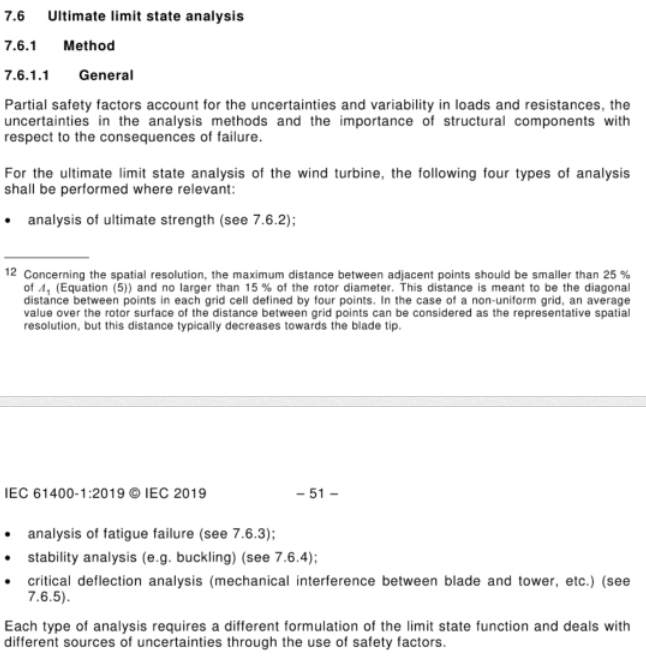
Partial safety factors account for the uncertainties and variability in loads and resistances, the uncertainties in the an alysis methods and the importance of structural components with respect to the consequences of failure.
For the ultimate limit state an alysis of the wind turbine, the following four types of an alysis shall be performed where relevant:
·an alysis of ultimate strength (see 7.6.2);
·an alysis of fatigue failure (see 7.6.3);
·stability a nalysis (e.g. buckling) (see 7.6.4);
·critical deflection an alysis (mechanical interference between blade and tower, etc.) (see 7.6.5).
Each type of an alysis requires a different formulation of the limit state function and deals with different sources of uncertainties through the use of safety factors.
7.6.1.2 Partial safety factors for loads and resistance
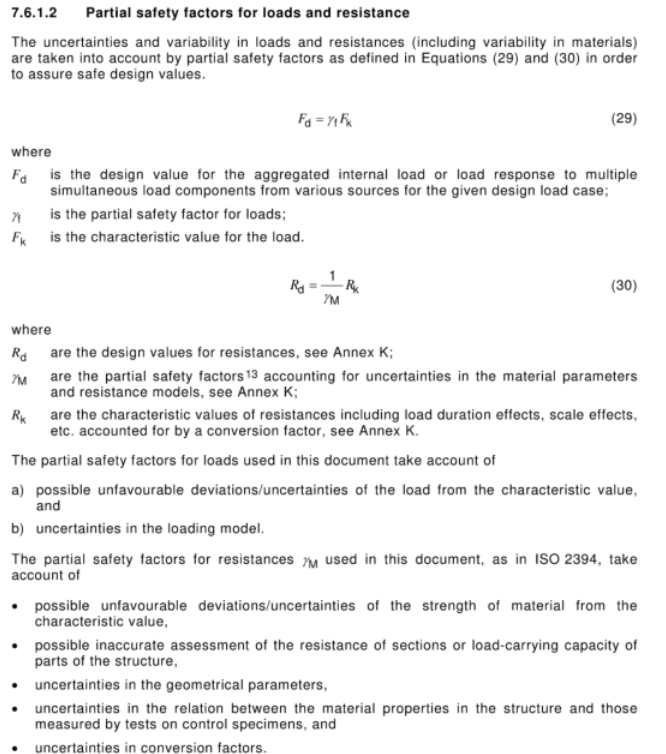
The uncertainties and variability in loads and resistances (including variability in materials) are taken into account by partial safety factors as defined in Equations (29) and (30) in order to assure safe design values.
Fd = γf Fk
where
Fd is the design value for the aggregated internal load or load response to multiple simultaneous load components from various sources for the given design load case;
γf is the partial safety factor for loads;
Fk is the characteristic value for the load.
Rd= Rk/γM
where
Rd are the design values for resistances, see Annex K;
γM are the partial safety factors accounting for uncertainties in the material parameters and resistance models, see Annex K;
Rkare the characteristic values of resistances including load duration effects, scale effects, etc. accounted for by a conversion factor, see Annex K.
The partial safety factors for loads used in this document take account of
a) possible unfavourable deviations/uncertainties of the load from the characteristic value, and
b) uncertainties in the loading model.
The partial safety factors for resistances γM used in this document, as in ISO 2394, take account of
·possible unfavourable deviations/uncertainties of the strength of material from the characteristic value,
·possible inaccurate assessment of the resistance of sections or load-carrying capacity of parts of the structure,
·uncertainties in the geometrical parameters,
·uncertainties in the relation between the material properties in the structure and those measured by tests on control specimens, and
·uncertainties in conversion factors.
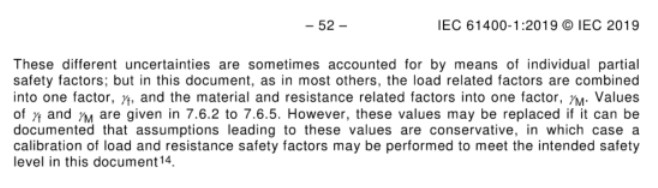
These different uncertainties are sometimes accounted for by means of individual partial safety factors; but in this document, as in most others, the load related factors are combined into one factor, γf , and the material and resistance related factors into one factor, γM. Values of γf and γM are given in 7.6.2 to 7.6.5. However, these values may be replaced if it can be documented that assumptions leading to these values are conservative, in which case a calibration of load and resistance safety factors may be performed to meet the intended safety level in this document¹⁴.
7.6 极限状态分析
7.6.1 分析方法
7.6.1.1 总则
分项安全系数用于考虑荷载与抗力自身的不确定性、离散性,分析方法带来的不确定性,以及构件失效后果对应的重要程度。
开展风力发电机组极限状态分析时,根据适用情况,应完成以下四类分析:
·极限强度分析(见 7.6.2);
·疲劳失效分析(见 7.6.3);
·稳定性分析(例如屈曲失稳,见 7.6.4);
·临界变形分析(叶片与塔筒发生机械干涉等,见 7.6.5)。
每一类分析需要建立不同的极限状态函数,并通过安全系数处理不同来源的不确定因素。
7.6.1.2 荷载与抗力分项安全系数
采用公式 (29)、(30) 定义的分项安全系数,考虑荷载、抗力(含材料性能离散性)的不确定性与离散性,以得到安全的设计取值。
Fd= γf Fk
式中:
Fd—— 给定荷载工况下,多种同步荷载分量组合得到的综合内力或荷载响应设计值;
γf —— 荷载分项安全系数;
Fk—— 荷载特征值。
Rd= Rk/γM
式中:
Rd—— 抗力设计值,参见附录 K;
γM—— 抗力分项安全系数 ¹³,考虑材料参数、抗力计算模型的不确定性,参见附录 K;
Rk—— 抗力特征值,已通过换算系数计入荷载持续效应、尺寸效应等影响,参见附录 K。
本标准荷载分项安全系数考虑:a) 荷载相对特征值可能出现的不利偏差与不确定性;b) 荷载模型本身存在的不确定性。
与 ISO 2394 保持一致,本标准抗力分项安全系数γM考虑:
·材料强度相对特征值可能存在的不利偏差与不确定性;
·截面抗力或结构构件承载能力评估存在误差;
·几何参数不确定性;
·结构实际材料性能与标准试样试验结果之间存在偏差;
·各类换算系数的不确定性。
各类不确定因素有时可采用多个独立分项系数分别考虑;但本标准与多数规范一致,将所有和荷载相关的影响合并为单一系数 γf,材料与抗力相关影响合并为单一系数γM。 γf和γM取值见 7.6.2~7.6.5。若能够证明原有取值对应的基本假设具备保守性,可替换系数取值;此时可重新标定荷载与抗力安全系数,保证达到本标准规定的目标安全水平 ¹⁴。
简短总结
本节规定风机极限状态需要开展极限强度、疲劳、稳定、临界变形四类分析。采用荷载分项系数 γf、抗力分项系数γM考虑各类不确定性,并给出荷载与抗力设计值计算公式;在满足保守性论证前提下,可重新标定安全系数。