【新文速递】2026年5月9日复合材料SCI期刊最新文章
今日更新:Composite Structures 1 篇,Composites Part B: Engineering 4 篇,Composites Science and Technology 1 篇
Composite Structures
Interfacial strengthening and dynamic mechanical properties of CF/PEEK composites with a water-based PAAs/Montmorillonite nanocomposite sizing agent
Yang Liu, Kaibao Wang, Zhilong Chang, Huirong Le
doi:10.1016/j.compstruct.2026.120434
水基PAAs/蒙脱土纳米复合施胶剂对CF/PEEK复合材料界面强化及动态力学性能的影响
This article conducted an investigation into the interfacial strengthening of carbon fiber-reinforced PEEK (CF/PEEK) through the modification of CF with a water-based PAAs/Montmorillonite (MMT) nanocomposite sizing agent. The surface roughness of CF exhibited a significant growth with the augmentation of MMT content. Compared with desized CF (e.g., DCF), the surface energy of PAAs/MMT-sized CF (e.g., PMCF1) increased by 503.95 %. The flexural strength, modulus, and interlaminar shear strength (ILSS) of PMCF1/PEEK increased by 61.24 %, 19.87 %, and 12.95 %, respectively. The interfacial strengthening can be explained by two factors: 1) increasing roughness and surface energy of CF due to MMT, and 2) enhanced interaction and molecular chains entanglement due to PI. Thinner CF fabrics contributed to a further enhancement of the mechanical properties of the composites. The flexural strength, modulus, and ILSS of TPMCF0.3/PEEK reached 800.82 MPa, 95.03 GPa, and 62.98 MPa, respectively. This is due to the higher CF volume fraction and resin impregnation of the thin CF fabric system. The flexural strength achieved in this study have an outstanding performance among related studies. The interface modification method described in this paper holds promise to enhance the strength of the CF/PEEK.
采用水基PAAs/蒙脱土(MMT)纳米复合施胶剂对CF进行改性,研究了碳纤维增强PEEK (CF/PEEK)的界面强化。随着MMT含量的增加,CF的表面粗糙度显著增大。与浆料CF(如DCF)相比,PAAs/ mmt浆料CF(如PMCF1)的表面能提高了503.95%。PMCF1/PEEK的抗弯强度、模量和层间剪切强度(ILSS)分别提高了61.24%、19.87%和12.95%。界面强化可以用两个因素来解释:1)MMT增加了CF的粗糙度和表面能;2)PI增强了相互作用和分子链纠缠。更薄的CF织物有助于进一步提高复合材料的机械性能。TPMCF0.3/PEEK的抗弯强度、模量和ILSS分别达到800.82 MPa、95.03 GPa和62.98 MPa。这是由于较高的CF体积分数和薄CF织物体系的树脂浸渍。本研究获得的抗弯强度在相关研究中表现突出。本文所描述的界面改性方法有望提高CF/PEEK的强度。
Composites Part B: Engineering
Electronic-Structure-Guided Ta/O Co-Doping Engineering Bulk and Interphase in Argyrodite Electrolytes for Solid-State Li Metal Batteries
Jie Yang, Siwu Li, Ziling Jiang, Kunpeng Tang, Lei Shi, Long Chen, Xiaobo Chen, Chen Liu, Chuang Yu
doi:10.1016/j.composites b.2026.113779
固态锂金属电池用银汞石电解质的电子结构引导Ta/O共掺杂工程体与界面
Argyrodite-based sulfide electrolytes are promising solid electrolytes for all-solid-state lithium metal batteries owing to their high ionic conductivity and favorable mechanical properties. However, poor air stability and severe interfacial reactivity with Li metal, which trigger continuous side reactions and dendrite growth, remain major obstacles to their practical application. Herein, we design a series of Ta/O co-doped chlorine-rich argyrodite electrolytes with the nominal composition Abstract to simultaneously regulate the PS4 3− tetrahedral framework and the Li|solid-state electrolyte (SSE) interphase. Rietveld refinement and density functional theory calculations reveal that Ta preferentially occupies P sites while O substitutes S in PS4 3− tetrahedra, leading to lattice expansion and a modified Li+ migration landscape. Although the room-temperature ionic conductivity decreases moderately with increasing Ta/O content, the optimized composition Li5.5P0.95Ta0.05S4.375O0.125Cl1.5 exhibits a substantially enhanced critical current density of 3.0 mA cm−2 (vs. 0.8 mA cm−2 for pristine L5.5PS4.5Cl1.5) and enables stable Li plating/stripping for over 500 h in Li|SSE|Li symmetric cells. Ta/O co-doping also improves the environmental robustness of the electrolyte by increasing its resistance to water adsorption and hydrolysis, thereby enhancing air stability. Interfacial an alysis via X-ray photoelectron spectroscopy depth profiling and morphology characterization demonstrates the formation of a Li–Ta–Sx rich interphase and Li–Ta alloy phases together with inorganic decomposition products, which homogenize Li deposition and effectively suppress dendrite penetration. When paired with a high-Ni ZrO2@NCM955 cathode, the optimized Ta/O co-doped electrolyte delivers a high discharge capacity of 118.4 mAh g−1 after 100 cycles at 1.0 C with 86.9% capacity retention, underscoring the potential of Ta/O engineered chlorine-rich argyrodites for high-energy, long-life sulfide-based all-solid-state lithium metal batteries.
银硫化物电解质具有较高的离子电导率和良好的力学性能,是全固态锂金属电池中很有前途的固体电解质。然而,较差的空气稳定性和与锂金属的强烈界面反应性引发了持续的副反应和枝晶生长,仍然是其实际应用的主要障碍。在此,我们设计了一系列的Ta/O共掺杂富氯银镁石电解质,其标称成分为Abstract,以同时调节PS4 3 -四面体框架和Li|固态电解质(SSE)界面相。Rietveld细化和密度泛函数理论计算表明,在PS4 3 -四面体中,Ta优先占据P位,而O取代S,导致晶格扩展和Li+迁移景观的改变。尽管室温离子电导率随着Ta/O含量的增加而适度降低,但优化后的组合物li5.5 p0.95 ta0.05 s4.3750 o0.125 cl1.5的临界电流密度显著提高至3.0 mA cm - 2(原始L5.5PS4.5Cl1.5为0.8 mA cm - 2),并能在Li|SSE|Li对称电池中稳定镀/剥离超过500小时。Ta/O共掺杂还通过增加其对水的吸附和水解的抵抗力,从而提高了电解质的环境稳健性,从而提高了空气稳定性。通过x射线光电子能谱深度剖面和形貌表征对界面进行分析,发现富Li - ta - sx界面相和Li - ta合金相以及无机分解产物的形成均质化了Li沉积,有效抑制了枝晶的渗透。当与高镍ZrO2@NCM955阴极配对时,优化的Ta/O共掺杂电解质在1.0 C下循环100次后可提供118.4 mAh g- 1的高放电容量,容量保留率为86.9%,这突显了Ta/O工程设计的富氯银离子电池在高能、长寿命硫化物基全固态锂金属电池中的潜力。
MIL-125(Ti)-derived core-shell TiO2@C composites for tunable and efficient microwave absorption
Liang Zhou, MUHAIMINUL ISLAM SHAKIL, Jingyi He, Xiyue Zhang, Hongbo Wang
doi:10.1016/j.composites b.2026.113764
MIL-125(Ti)衍生核壳TiO2@C复合材料可调谐和有效的微波吸收
Metal-organic framework (MOF)-derived carbon materials exhibit significant advantages for microwave absorption applications, owing to their high electrical conductivity, structural tunability, and abundant intrinsic defects and heterogeneous interfaces. However, achieving an optimal balance between magnetic and dielectric losses remains challenging for most magnetic metal-based MOFs-derived absorbers. In this study, MIL-125(Ti) was prepared as a template, and TiO2@C-x composites were synthesized via a two-step pyrolysis method. Experimental results demonstrate that the pyrolysis temperature significantly affects the graphitization degree of the carbon matrix and the formation of TiO2 nanoparticles, thereby playing a dominant role in the dielectric and microwave absorption properties of the investigated MIL-125(Ti)-derived core-shell TiO2@C composites. Notably, the TiO2@C-700 composite delivers an effective absorption bandwidth of 3.2 GHz in 9.2-12.4 GHz at a thickness of 2.01 mm. Therefore, the MIL-125(Ti)-derived TiO2@C composites fabricated in this study establish a viable and nonmagnetic strategy for designing tunable, lightweight, and high-performance MOF-derived microwave absorbers.
金属有机骨架(MOF)衍生的碳材料由于其高导电性、结构可调性、丰富的本征缺陷和非均相界面,在微波吸收应用中具有显著的优势。然而,实现磁性和介电损耗之间的最佳平衡对于大多数磁性金属基mofs衍生吸收剂来说仍然是一个挑战。本研究以MIL-125(Ti)为模板,采用两步热解法合成TiO2@C-x复合材料。实验结果表明,热解温度显著影响碳基体的石墨化程度和TiO2纳米颗粒的形成,从而对MIL-125(Ti)衍生核壳TiO2@C复合材料的介电和微波吸收性能起主导作用。值得注意的是,TiO2@C-700复合材料在厚度为2.01 mm时,在9.2-12.4 GHz范围内提供了3.2 GHz的有效吸收带宽。因此,本研究中制备的MIL-125(Ti)衍生TiO2@C复合材料为设计可调谐、轻量化和高性能的mof衍生微波吸收器建立了一种可行的非磁性策略。
Enhancing CFRP hole-making quality via ultrasonic vibration-assisted bi-directional drilling
Chaoqun Wu, Wenjian Huang, Shiyu Cao, Yufei Tang
doi:10.1016/j.composites b.2026.113745
超声振动辅助双向钻进提高CFRP成孔质量
To address the critical issues of delamination, burr formation, and poor hole wall quality that frequently occur during Carbon Fiber Reinforced Plastics (CFRP) drilling and severely compromise assembly accuracy in aviation, aerospace, marine, and automotive industries, this study proposes a novel ultrasonic vibration-assisted bi-directional drilling (UVABD) method that combines the damage suppression advantages of bi-directional drilling and ultrasonic vibration-assisted drilling for high-quality and high-efficiency CFRP hole-making. Owing to the interlaminar bonding characteristics and anisotropy of CFRP that result in hole exit damage and poor hole wall quality, the positive effect of bi-directional drilling on exit damage suppression is first clarified based on a reverse feeding an alysis, a comparative a nalysis of the critical thrust force and drilling process between conventional drilling and bi-directional drilling is performed considering the internal support effect of bi-directional drilling, and ultrasonic vibration is introduced to further improve the hole wall quality. Experimental results from different CFRP drilling methods indicate that compared to conventional drilling, bi-directional drilling and UVABD can reduce delamination by 62.9% and 72.7%, respectively, while reducing burr formation by 98.6% and 97.9%, respectively. Additionally, the introduction of vertical ultrasonic vibration can reduce hole wall roughness by up to 9.1%. The proposed UVABD method achieves synergistic performance improvement, effectively suppressing drilling exit defects and enhancing hole wall quality simultaneously, which can provide an important reference for the precision and efficient hole-making of CFRP.
为了解决碳纤维增强塑料(CFRP)钻孔过程中经常出现的分层、毛刺形成和孔壁质量差的关键问题,并严重影响航空、航天、船舶和汽车行业的装配精度,本研究提出了一种新型超声振动辅助双向钻进(UVABD)方法,该方法结合了双向钻进和超声振动辅助钻进的损伤抑制优势,实现了高质量、高效率的CFRP制孔。由于CFRP的层间粘结特性和各向异性导致了孔出口损伤和孔壁质量差,首先通过反向进给分析阐明了双向钻进对出口损伤抑制的积极作用,考虑双向钻进的内部支撑效应,对常规钻进和双向钻进的临界推力和钻进过程进行了对比分析;并引入超声振动,进一步改善孔壁质量。不同CFRP钻孔方式的实验结果表明,与常规钻孔相比,双向钻孔和UVABD可分别减少62.9%和72.7%的分层,减少毛刺的形成分别为98.6%和97.9%。此外,垂直超声振动的引入可使孔壁粗糙度降低9.1%。所提出的UVABD方法实现了性能的协同提升,在有效抑制钻出口缺陷的同时提高了孔壁质量,可为CFRP的精密高效制孔提供重要参考。
Multiscale Interfacial Engineering for the Scalable Fabrication of High-Performance Ag2Se-Coated Carbon Fiber Thermoelectric Yarns for Human Body Heat Harvesting
Xinxing Zhou, Bo Wu, Kerui Li, Chengyi Hou, Qinghong Zhang, Yaogang Li, Hongzhi Wang
doi:10.1016/j.composites b.2026.113728
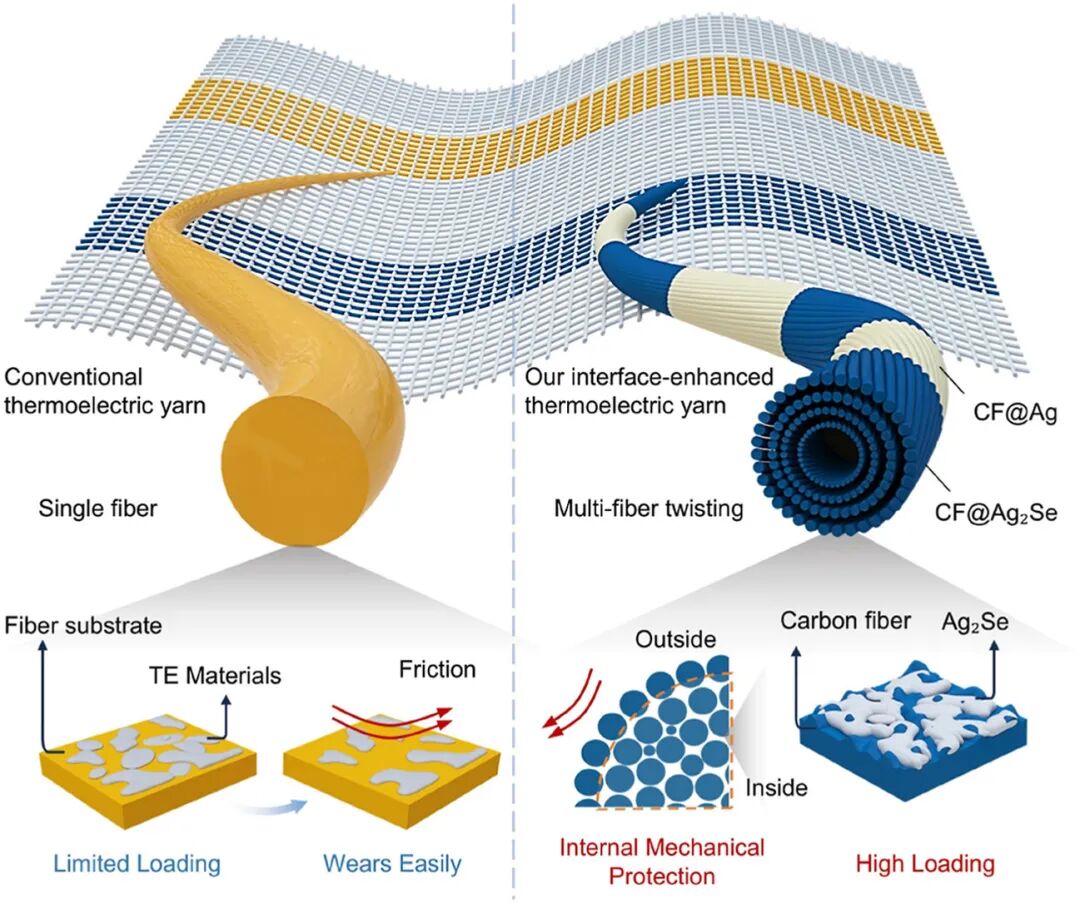
人体热采集用高性能镀银碳纤维热电纱的多尺度界面工程
Fiber-shaped thermoelectric devices hold great promise for practical applications owing to their flexibility, high integration density, and weavability; however, their deployment is still limited by complex fabrication processes, insufficient material performance, and performance degradation induced by friction and fatigue during service. In this work, we use carbon fibers as the core substrate and implement multiscale interfacial engineering to enable high-performance Ag2Se loading. At the microscopic level, surface roughening and chemical activation of the carbon fibers markedly enhance the loading efficiency of Ag2Se on the fiber surface. At the structural level, mechanically twisting numerous fine carbon filaments into robust interlocked yarns effectively suppresses interfacial wear and structural damage during operation. Based on this strategy, we realize high-performance Ag2Se-coated carbon fiber thermoelectric yarns that exhibit a stable and high room-temperature power factor (> 330 μW m-1 K-2) and retain reliable electrical performance after more than 1000 friction cycles. When woven into TE fabrics, the resulting textiles achieve a power density of ∼0.81 μW cm-2 under human body heat, comparable to state-of-the-art fiber-based TE devices, while simultaneously offering simple processing and excellent scalability.
纤维形状的热电器件由于其灵活性、高集成密度和可织性而具有很大的实际应用前景;然而,它们的部署仍然受到复杂的制造工艺、材料性能不足以及在使用过程中摩擦和疲劳引起的性能下降的限制。在这项工作中,我们使用碳纤维作为核心衬底,并实施多尺度界面工程,以实现高性能Ag2Se加载。微观层面上,碳纤维表面粗化和化学活化显著提高了Ag2Se在纤维表面的负载效率。在结构层面,将大量的细碳丝机械捻制成坚固的互锁丝,有效地抑制了运行过程中的界面磨损和结构损伤。基于该策略,我们实现了高性能的ag2se涂层碳纤维热电纱线,具有稳定的高室温功率因数(> 330 μW m-1 K-2),并且在超过1000次摩擦循环后仍保持可靠的电气性能。当编织到TE织物中时,所得纺织品在人体热量下的功率密度达到~ 0.81 μW cm-2,与最先进的基于纤维的TE设备相当,同时提供简单的加工和出色的可扩展性。
Composites Science and Technology
Precision orientation of hydrogen evolution performance of iron-based electrocatalysts empowered by machine learning: From electronic structure regulation to rational construction
Yan Hu, Senlin Tian, Yingjie Li
doi:10.1016/j.compscitech.2026.111682
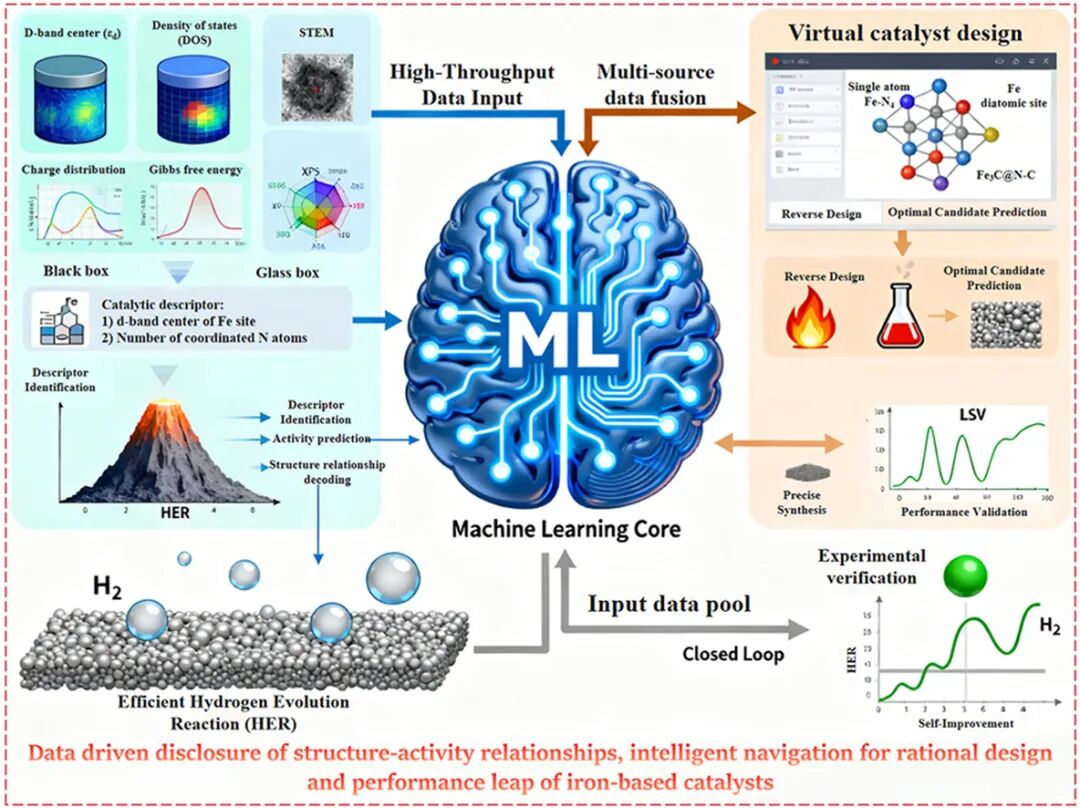
基于机器学习的铁基电催化剂析氢性能的精确定向:从电子结构调控到合理构造
The efficient realization of hydrogen economy urgently requires the development of low-cost and high-performance electrocatalytic hydrogen evolution (HER) catalysts. Although iron-based materials are abundant in resources, low-cost, and have adjustable electronic structures, their performance optimization faces challenges such as multivariable nonlinear coupling, difficulty in maximizing active sites and coordinating stability. Traditional trial and error methods and single scale theoretical simulations have limitations in efficiency and accuracy. This review systematically elaborates on how machine learning (ML), as a transformative research paradigm, empowers iron-based HER catalysts from precise electronic structure control to rational macroscopic performance construction through deep mining of hidden patterns in high-throughput computing and experimental data. ML can not only establish fast quantitative prediction models from composition, structure to key electronic descriptors (such as d-band center, ΔG*H), but also reverse engineer new material structures with ideal performance through generative models and optimization algorithms, and intelligently plan their synthesis paths. A detailed overview of the methodological progress and application cases of ML in electronic structure quantification, defect and interface effect an alysis, single atom catalyst design, and stability evaluation was provided, revealing the key role of ML in discovering novel physical descriptors and elucidating complex synergistic mechani s ms. Finally, a closed-loop intelligent development system that integrates physical information modeling, automated experiments, and digital twin technology is proposed, providing a comprehensive theoretical framework and technical roadmap for the precise directional design of the new generation of high-performance and high stability iron-based electrocatalysts.
高效实现氢经济迫切需要开发低成本、高性能的电催化析氢催化剂。尽管铁基材料具有资源丰富、成本低、电子结构可调等优点,但其性能优化仍面临多变量非线性耦合、活性位点难以最大化和协调稳定性等挑战。传统的试错法和单尺度理论模拟在效率和准确性上存在局限性。本文系统阐述了机器学习(ML)作为一种变革性的研究范式,如何通过深入挖掘高通量计算和实验数据中的隐藏模式,使铁基HER催化剂从精确的电子结构控制到合理的宏观性能构建。ML不仅可以建立从成分、结构到关键电子描述符(如d波段中心、ΔG*H)的快速定量预测模型,还可以通过生成模型和优化算法对性能理想的新材料结构进行逆向工程,并智能规划其合成路径。详细概述了机器学习在电子结构量化、缺陷和界面效应分析、单原子催化剂设计和稳定性评价等方面的方法进展和应用案例,揭示了机器学习在发现新的物理描述符和阐明复杂协同机制方面的关键作用。最后,提出了集物理信息建模、自动化实验和数字孪生技术于一体的闭环智能开发系统,为新一代高性能高稳定性铁基电催化剂的精准定向设计提供了全面的理论框架和技术路线图。