C4-C10 烷烃自燃统一详细动力学模型研究(MTBE_ETBE_nHeptane)

摘要:
本文提出一套适用于 C₄–C₁₀烷烃在 600–1200 K 范围内自燃的统一详细动力学模型,由 EXGAS 软件自动生成机理并采用单一动力学参数集。研究对象包括正丁烷、正戊烷、异戊烷、新戊烷、正庚烷、异辛烷、正癸烷及其混合物,验证数据来自激波管与快速压缩机,压力 1–50 bar,当量比 0.5–2。模型优化了热化学数据、自由基加成、异构化、环醚生成与氢过氧化物分解速率,能较好复现着火延迟与负温度系数区行为。灵敏度分析表明烷基与过氧自由基加氧是关键步骤,模拟结果与辛烷值趋势一致,为 HCCI 发动机与安全氧化过程提供可靠机理。
Progress toward a unified detailed kinetic model for the autoignition of alkanes from C4 to C10 between
600 and 1200 K
F. Buda, R. Bounaceur, V. Warth, P.A. Glaude, R. Fournet, F. Battin-Leclerc*
Département de Chimie Physique des Réactions, UMR 7630 CNRS-INPL, ENSIC, 1, rue Grandville, BP 451,
54001 Nancy Cedex, France
Received 22 July 2004; received in revised form 21 January 2005; accepted 6 March 2005
Available online 15 April 2005
Abstract
A unified model with a single set of kinetic parameters has been proposed for modeling the autoignition delay times of a wide range of alkanes using detailed kinetic mechanis ms automatically generated by software EXGAS. The validations were based on recent data of the literature obtained in shock tubes and in rapid compression ma- chines. The compounds studied were n-butane, n-pentane, iso-pentane, neo-pentane, 2-methylpentane, n-heptane, iso-octane, n-decane, and mixtures of n-heptane and iso-octane. Investigated conditions are the following: tem- peratures range from 600 to 1200 K, including the negative temperature coefficient (NTC) region, pressures range from 1 to 50 bar, and equivalence ratios range from 0.5 to 2. Tests were also performed for results obtained in a jet-stirred reactor and a sensitivity an alysis was performed in the case of n-heptane. Simulations using generated mechanis ms for the nine isomers of heptane were performed and showed that the variations of autoignition delay times follows globally well that of octane numbers at 650 K in a rapid compression machine at 4 bar. The influence of pressure (from 3 to 200 bar) was theoretically investigated.
◎ 2005 The Combustion Institute. Published by Elsevier Inc. All rights reserved.
Keywords: Alkanes; Autoignition; Oxidation; Detailed kinetic model
1. Introduction
A better understanding of autoignition phenom- ena and of the fundamentals of hydrocarbon oxidation is a very important challenge both to develop new types of engines and to improve the safety in oxida- tion processes.
*Corresponding author. Fax: +33 3 83 37 81 20. E-mail address:frederique.battin-leclerc@ensic.inpl-nancy.fr (F. Battin-Leclerc).
An engine based on a homogeneous charge and compression ignition (HCCI) has the potential to pro- vide both diesel-like efficiencies and extremely low emissions. This new type of engine relies on a lean combustion process (in excess of air), which results in a large decrease of particulate matter emission and of the amount of nitric oxide (NOx) produced, which favors the creation of tropospheric ozone in urban ar- eas. Fundamentally, the reason is the avoidance of regions within the engine, with either fuel-rich condi- tions that generate particulate matter or stoichiometric conditions that generate high temperature and NOx emissions. In order to further develop HCCI engines, it is important to predict the time when the autoigni- tion of the homogeneous mixture occurs during the compression cycle and to model the formation of pol- lutants according to the fuel composition [1].
Large-scale hydrocarbon (partial) oxidation proc- esses form the basis of much of the (petro-) chemical process industry and in particular of the production of feedstock for polymer production (such as ethyl- ene and propylene oxide, and maleic and terephthalic acid). To prevent explosions, the industry worldwide is in need of basic safety information, safety tools, and predictive safety software for design of equipment un- der all anticipated operating conditions. It is common knowledge that gas and vapor explosions are one of the specific risks ofthe chemical industry. Much time and money are therefore spent in preventing such ex- plosions, for example, by eliminating all potential ig- nition sources. Often one considers the usual ignition sources such as flames, hot surfaces, and sparks, but forgets that sufficiently high temperatures can lead to autoignition of the fuel–air mixture [2].
The chemistry of hydrocarbon oxidation is very complex: a mixture of hydrocarbons and air can re- act either in a slow combustion process or through an uncontrolled exponential increase at a rate which leads to ignition. Detailed kinetic mechanis ms, which are based on elementary steps, are a useful way to describe this complex chemistry over a wide range of temperatures, pressures, and equivalence ratios. Since these models include mainly elementary steps, the rate constants of which depend only on temper- ature and pressure, they can be used in a predictive way. Detailed reaction mechanis ms of the oxidation of hydrocarbons in the gas phase have been developed worldwide over several decades. Most studies have been confined to oxidation chemistry at temperatures above about 1000 K with only a limited attention paid to detailed kinetic models in important lower temper- ature regime [3].
A major problem in constructing a detailed chem- ical kinetic model, especially at low temperatures, is the very large number of possible reactions, products, and reaction intermediates involved. Because man- ual assembly of a comprehensive kinetic model is extremely difficult and prone to error, the only prac- tical way to construct and use large models lies in the use of formal computer-based methods. Papers on the automatic generation of mechanis ms for py- rolysis, combustion, and oxidation were published by different authors worldwide (e.g., in the last decade, by Ranzi et al. [4], Blurock [5], or Susnow et al. [6]). Our laboratory has been developing for several years a computer package (EXGAS) to automatically gen- erate detailed kinetic models for the gas-phase oxida- tion and combustion of normal and branched alkanes, which are important components of classical gaso-line and diesel fuels, and which could be used in new fuels for HCCI engines. This software was al- ready validated by modeling the slow oxidation of several alkanes (e.g., n-butane [7], n-heptane [8,9], iso-octane [8,9], n-octane[10], n-decane[10,11], and mixtures of n-heptane and iso-octane [12]) and the autoignition of iso-butane and iso-pentane in a shock tube from 1100 to 2000 K [13]. Nevertheless, apart from the case of n-butane [7], the models generated by EXGAS have not been previously tested to repro- duce autoignition delay times at low temperatures in the zone of the negative temperature coefficient.
The purpose of this paper is to describe and an alyse a single set of kinetic parameters which al- lowsthe generation of the detailed kinetic models using EXGAS to reproduce most of the published experimental results concerning the autoignition of linear and branched alkanes (from C4) below 1200 K.
2. Summary of recently published experimental results concerning the autoignition of alkanes
The experimental results concerning the autoigni- tion below 1200 K of alkanes from C4, which have been published in the last decade, are shown in Ta- ble 1. Two types of experimental facilities have been used: shock tubes and rapid compression machines.
In a shock tube, ignition delay time is usually mea- sured behind reflected shock waves, while the cor- responding temperature is calculated from the inci- dent shock wave velocity with an error estimated at 20 K [21]. The apparatus used by Adomeit and co- workers [21,23,24] allowed them to work with air– hydrocarbon mixtures for pressures behind reflected shock waves up to 50 bar and then to observe au- toignition at temperatures from 660 K.
Three rapid compression machine facilities have been used to measure autoignition delay times. One is at Leeds University with a compression time of 22 ms [16–18], a second one is used by the Univer- sity of Lille with a compression time of 60 ms [14,15, 20,22,25], and a third one is located at the University of Galway and has a compression time of 17 ms [19]. In these rapid compression machines, ignition delay time is measured from the end of the compression. The temperature, Tc , of the compressed gas is calcu- lated for an adiabatic core gas from the initial pres- sure, P0, and temperature, T0, the compressed pres- sure, Pc , and the ratio of specific heats (γ = Cp/Cv) by the equation [20]:
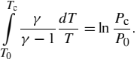
Table 1
Summary of the experimental results published since 1993 concerning the autoignition of alkanes from C4 below 1200 K
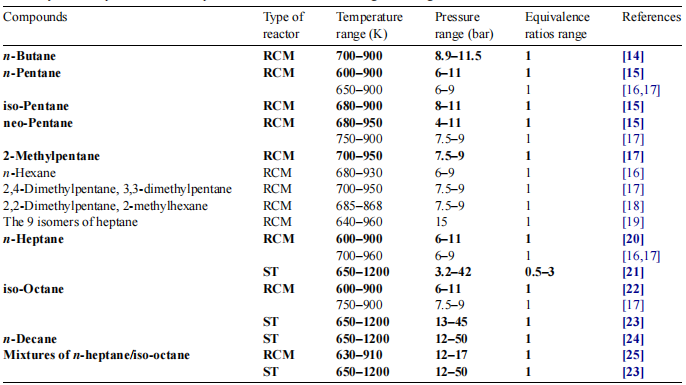
Note. ST, shock tube; RCM, rapid compression machine. The results given in bold have been used in the validations presented in this paper.
Several experimental studies have demonstrated that the details of the heat transfer in a rapid com- pression machine are quite complex, both with re- spect to the geometry and over the time history of the experiments [18,26]. This is of particular im- portance for compounds with the longest ignition delay times and it has been shown that simula- tions with a simple physical model encounter prob- lems in reproducing the experimental results ob- tained in Leeds for very branched alkanes (i.e., iso- octane, 2,2-dimethylpentane, 2,4-dimethylpentane, 3,3-dimethylpentane), for which a region of temper- ature, in which no autoignition was experimentally observed, was found for temperatures around 750 K [18]. The results obtained in Galway showed also a region of temperature in which no autoignition was experimentally observed for 2,2,3-trimethylbutane, and a strongly pronounced negative temperature co- efficient was observed for dimethylpentanes [19]. In addition, temperature gradients have been observed in the combustion chamber of such an apparatus [27], which can greatly influence the measurement of the observed products.
We have mainly used for the validations presented thereafter the results obtained in the rapid compres- sion machine of Lille, which has a slower stroke and a specific geometry [18] and allows autoigni- tion to be experimentally recorded for iso-octane in all the temperature ranges studied. In the case of 2-methylpentane, which was not tested at Lille and has rather short ignition delay times, we have used data from Leeds. Some tests involving the results of Galway have also been made and will be pointed out further in the text.
3. Description of the unified detailed kinetic mechanis ms
The detailed kinetic mechanis ms used in this study have been automatically generated by the computer package EXGAS [7–12]. We will recall here very briefly the main features of this software, which has already been much described, and we will present the improvements of the thermochemical data and of the generic rate constants needed to obtain correct simu- lations of autoignition delay times.
3.1. General features of EXGAS
The system provides reaction mechanis ms made of three parts.
(1) A comprehensive primary mechanis m, where the only molecular reactants considered are the ini- tial organic compounds and oxygen. According to the choices of the user, the reactant and the primary rad- icals can be systematically submitted to the different types of following elementary steps:
• unimolecular initiations involving the breaking of a C–C bond;
• bimolecular initiations with oxygen to produce alkyl and ·HO2 radicals;
• oxidations of alkyl radicals with O2 to form alkenes and HO2 · radicals;
• additions of alkyl (R·) and hydroperoxyalkyl ( QOOH) radicals to an oxygen molecule;
• isomerizations of alkyl and peroxy radicals (ROO · and ·OOQOOH) involving a cyclic tran- sition state; for ·OOQOOH radicals, we consider a direct isomerization-decomposition to give ke- tohydroperoxides and hydroxyl radicals [28];
• decompositions of radicals by β-scission involv- ing the breaking of C–C or C–O bonds for all types of radicals (for low-temperature modeling, the breaking ofC–H bonds is neglected);
• decompositions of hydroperoxyalkyl radicals to form cyclic ethers and ·OH radicals;
• metatheses involving H abstractions by radicals from the initial reactants;
• recombinations of radicals;
• disproportionations of peroxyalkyl radicals with HO2· to produce hydroperoxides and O2(dispro- portionations between two peroxyalkyl radicals or between peroxyalkyl and alkyl radicals are not taken into account).
(2) A C0–C2 reaction base, including all the reac- tions involving radicals or molecules containing fewer than three carbon atoms [29]. The fact that no generic rule can be derived for the generation of the reactions involving very s mall compounds makes the use of this reaction base necessary.
(3) A lumped secondary mechanis m, containing the reactions consuming the molecular products of the primary mechanis m, which do not react in the reaction base. To reduce the number of reactants in the secondary mechanis m, the molecules formed in the primary mechanis m, with the same molecular for- mula and the same functional groups, are lumped into one unique species, without distinguishing between the different isomers. The reactions of these lumped molecules are not elementary steps, but global reac- tions, which produce, in the s mallest number of steps, molecules or radicals whose reactions are included in the reaction bases [7].
3.2. Thermochemical data
Thermochemical properties play an important role in the overall reactivity of the system, as the rate of the reverse reactions is computed through those val- ues. That is of particular importance in the case of the additions of a radical to an oxygen molecule, which the influence of the reverse reaction increases with temperature and has a strong effect on reactivity.
Thermochemical data for molecules or radicals were automatically calculated and stored as 14 poly- nomial coefficients, according to the CHEMKIN II formalis m [30]. These data were automatically cal- culated using software THERGAS [31], based on the group and bond additivity methods proposed by Ben- son [32].
The method for evaluating the thermochemi- cal properties of branched compounds in software THERGAS has been slightly modified. In previous versions of THERGAS [31], thermochemical prop- erties of branched compounds were calculated using gauche corrections suggested by Benson [32]. These corrections are necessary for describing steric effects. Group values have been updated based on the data of Domalski and Hearing [33], which use the method of methyl-group corrections. These authors have up- dated Benson databases with new molecules, and replaced the gauche corrections used by Benson by a methyl-group correction that systematically adds a correction for each methyl groups depending on whether they are linked to a tertiary or a quaternary atom of carbon. For instance, the estimation of ther- modynamic properties of 2-methylpentane requires that a correction for two methyl groups linked to a tertiary atom of carbon be taken into account.
The enthalpies of formation of alkyl radicals and peroxy radicals have been updated according to the values of bond dissociation energies recently pub- lished by Tsang [34] and by Luo [35] and following the recommendations of Benson and Cohen [36], re- spectively.
3.3. Description of the generic rate constants
Table 2 presents the set of generic rate constants, which are used by EXGAS for the primary mecha- nis m of the oxidation of alkanes, apart from the ki- netic data of isomerizations, recombinations and the unimolecular decompositions, which are calculated using the software KINGAS [37], based on thermo- chemical kinetics methods [32]. The main features of these calculations have been summarized in previ- ous descriptions of EXGAS [7–12]. The kinetic data which cannot be calculated by KINGAS are estimated from correlations, which are based on quantitative structure–reactivity relationships and obtained from a literature review. The estimation of the rate constants used in the secondary mechanis m is based on cor- relations derived from that proposed for the primary mechanis m and has been previously described [7].
Simulations using the previously presented set of kinetic parameters [7–12] were performed and showed an overprediction of autoignition delay times.
Table 2
Kinetic parameters for the primary mechanis m of the oxidation of alkanes not calculated using KINGAS [37]
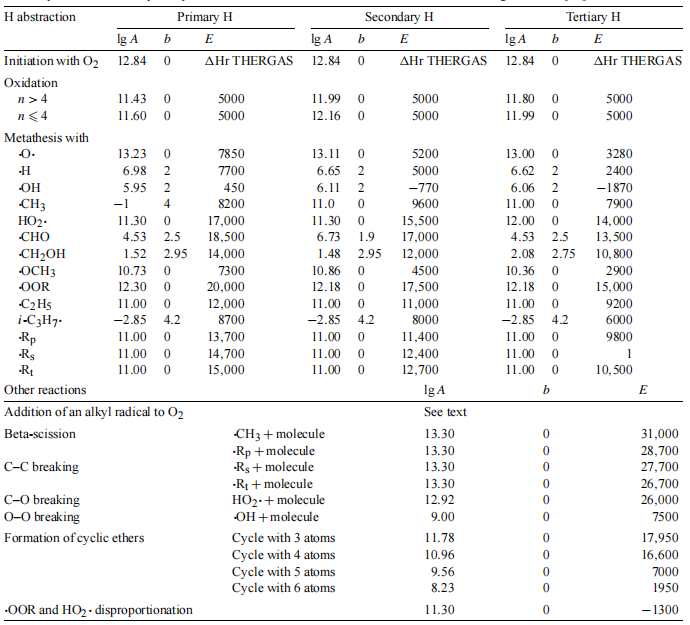
Note. Rate constants are expressed in the form k = ATb exp(-E/RT ), with the units cm3 , mol, s, kcal, by H atoms which can be abstracted. ·Rp , ·Rs , ·Rt are primary, secondary, and tertiary alkyl free radicals. n is the number of atoms of carbon in an alkyl radical.
in a shock tube and in a rapid compression machine for the alkanes studied. Sensitivity an alyses, flow rate an alyses, and different tests have led us to propose improvements of the estimation of kinetic parameters for five types of reactions of the primary mechanis m and one type of the secondary mechanis m. The skele- ton of the model and the a priori simplifications based on the reactivity of free radicals remain the same [28].
3.4. Bimolecular initiations
The rate constants of the bimolecular initiations with oxygen molecules, for which we previously used values proposed by Chevalier et al. [38], are not very sensitive parameters for the calculation of the igni- tion delay times as it will be shown further in the text.
Nevertheless, to be consistent with the values that we consider in the case of alkenes [39] and which are those experimentally measured by Ingham et al. [40], the rate parameters for this type of reaction have been taken equal to the estimation proposed by these au- thors for alkanes: A = 7.0 ×10¹² mol-1 cm3 s-1 (per abstractable H atom) with the activation energy taken equal to the enthalpy of reaction and being automati- cally calculated using the software THERGAS [31].
3.5. Oxidations of alkyl radicals with O2 to form alkenes and HO2 · radicals
The rate constants of oxidation are sensitive para- meters as this reaction leads to alkenes and the very unreactive ·HO2 radicals and acts then almost like a termination step. As discussed by Walker and Mor- ley [41], the mechanis m of this reaction has been the subject of considerable controversy and the values of these rate parameters are not well known for alkyl rad- icals heavier than ethyl radicals. Our previous values [7] were based on a structure–reactivity relationship proposed by Stocker and Pilling [42]. In the present work, A factors have been 20% increased for alkyl radicals containing more than four atoms of carbon and 70% increased for s maller alkyl radicals, but the activation energy has been kept equal to 5 kcal/mol as proposed by Walker [43]. The fact that the rate constants is higher for s maller radicals traduces the fact that adduct yield by the addition of an alkyl rad- ical to oxygen can be less easily stabilized in species containing less bonds for the excess energy to be dis- tributed and then can more easily break down to give the conjugated alkene and a ·HO2 radical.
3.6. Addition of branched alkyl radicals to an oxygen molecule
The rate constant of the addition of alkyl radical to an oxygen molecule has also an important influ- ence because it directly competes with the oxidation. In previous work, we used the same value (k add = 2.2 × 10¹⁹ T__2.5 mol_1 cm3 s_1 ) for the addition of every alkyl radical to an oxygen molecule. This value leads to good results in the cases of every linear alkyl radical, but not in the case of branched alkyl radicals. For linear and branched alkyl radicals, we now use an additivity method to take more closely into account the structure of each considered radical,
k add= npkp + nsks + ntkt + nqkq ,
where np is the number of primary groups (CH3) linked to the radicalar atom of carbon, ns is the number of secondary groups (CH2) linked to the radicalar atom of carbon, nt is the number of ter- tiary groups (CH) linked to the radicalar atom of carbon, n q is the number of quaternary groups (C) linked to the radicalar atom of carbon, kp = 8.0 × 10¹⁸ T__2.5 cm3 mol_1 s_1 , ks = 9.0 × 10¹⁸ T__2.5 cm3 mol_1 s_1 , kt = 1.5×10¹⁸ T__2.5 cm3 mol_1 s_1 , kq = 1.0 × 10¹⁸ T__2.5 cm3 mol_1 s_1 .
The principle of this additivity method was pro- posed by Stocker and Pilling [42].
For a tertiary radical, k add = kt if the atom of car- bon carrying the radical center is linked to at least one tertiary group and k add = kq if it is linked to at least one quaternary group.
It is worth noting that the obtained values for lin- ear alkyl radicals are close to the previously used one, while most of them are much lower for branched rad- icals, such as iso-octyl radicals, as shown in Table 3,
Table 3
Kinetic parameters for the additions of iso-octyl radicals to an oxygen molecule
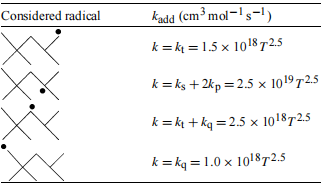
which presents an example of use of the proposed ad- ditivity method.
3.7. Isomerization of alkylperoxy radicals to hydroperoxy alkyl radicals
As described in a previous paper [7], preexponen- tial factor (A) is mainly based on the changes in the number of internal rotations as the reactant moves to the cyclic transition state and activation energies have been set equal to the sum of the activation energy for H abstraction from the substrate by an alogous radi- cals (EH-abstr, see Table 4a) and the strain energy of the cyclic transition state (Ering, seeTable 4b).
E = EH-abstr + Ering
In order to improve our simulation in the case of n-butane, the strain energies of the cyclic transi- tion state containing two oxygen atoms are now taken equal to 8 kcal/mol (instead of 8.5 kcal/mol, previ- ously) for a six-member ring. This is consistent with the uncertainty on the measured rate constant of this isomerization.
In addition, we have refined our estimation of EH-abstr in the case of (1) the abstraction of a hydro- gen atom borne by an atom of carbon linked to an atom of oxygen and of the reverse reaction, (__1), the abstraction by a radical in which the radical center is carried by an atom of carbon linked to an atom ofoxy- gen.
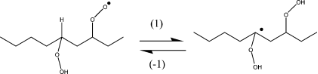
In the case of the type of isomerization (1), EH-abstr have been considered to be 2 kcal/mol lower than those of the similar reactions in the case of an atom of carbon linked to only atoms of carbon or of hydrogen or a radical center. The value (ΔE1 =_2 kcal/mol) corresponds to the difference in activa- tion energy between the abstraction by ethyl radicals at 800 K of an atom of hydrogen from methanol [44] and that of a primary atom of hydrogen from propane [45]. Table 4c presents examples of rate constants ob- tained for isomerizations and details the calculation of the activation energies including a case for whichthe 2 kcal/mol correction is needed.
In the case of the type of isomerization (_1), EH-abstr have been increased by 6 kcal/mol. This value (ΔE1) has been obtained from that of isomer- ization (1) using thermochemistry (ΔE _ 1 = Δenth + ΔE1). According to THERGAS [31], the difference in enthalpies of reaction of the H abstraction by ·C2H5 radicals and by CH3CHOH radicals (Δenth) is close to 8 kcal/mol at 800 K. The obtained in- crease, 6 kcal/mol, is then consistent with the fact that the activation energy of the H abstraction from ethane is 7 kcal/mol higher by ·CH2OH radicals than by methyl radicals [46].
Table 4
Parameters used for the calculation of the rate constants of internal isomerizations of alkylperoxy and hydroperoxy alkylperoxy free radicals
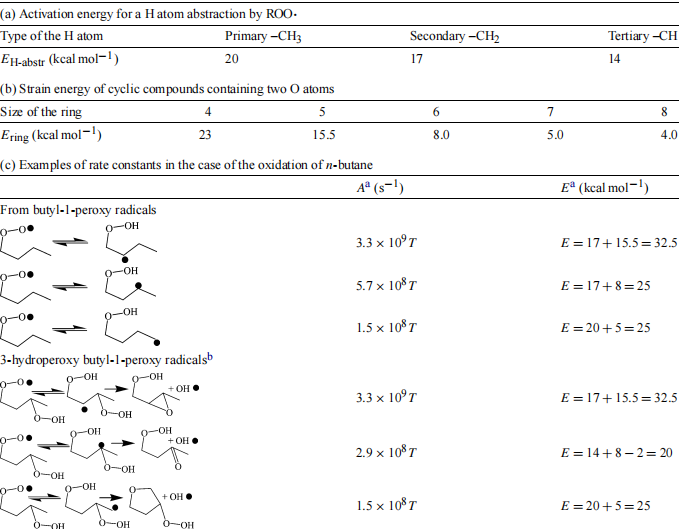
a The reactions are considered as reversible and the rate parameters are those of the direct step.
b The direct isomerization/decomposition is considered with the rate constant of the isomerization.
3.8. Formation of cycloethers
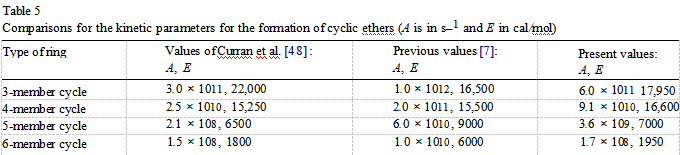
The formation of cycloethers competes directly with the second addition to oxygen, which leads ul- timately to the formation of hydroperoxides, and has then an inhibiting effect on the global reactivity. The rate constants of these reactions are thus very sen- sitive parameters, but a direct measurement is only available for the formation of 4-member rings dur- ing the oxidation of neo-pentane [47] (k = 2.0 × 10¹¹ exp(_7830/T ) s_1 ) and the parameters used for other cycles rely only on estimations. The new values, which are closer to those proposed by Curran et al.
[48] for the 5- and 6-member rings as shown in Ta-ble 5, lead to better results for ignition delay times than our previous estimations [7–12].
3.9. Decomposition of hydroperoxides molecules in the secondary mechanis m
Hydroperoxides (hydroperoxy cycloethers or ke- tohydroperoxide species) are degenerate branching agents, which can easily decompose by breaking an O–OH bond and induce an increase of the amounts of ·OH radicals which ensure the propagation of the reaction. The reactivity of alkanes is directly related to the amounts of hydroperoxides formed and the rate constant of the decomposition of these compounds is then an important parameter. The value for this de- composition used up to now, in the secondary mech- anis ms generated by EXGAS, was obtained from an estimation of Benson [32]; the new values have been derived from a measurement of Sahetchian et al. [49] for the decomposition of hydroperoxides and are the following:
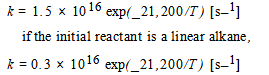
if the initial reactant is a branched alkane.
As explained previously [7], to avoid a uncon- trolled increase of the size of the mechanis m, the secondary mechanis m generated by EXGAS does not contain elementary steps, but globalized reactions. The lower value of the rate constant branched com- pounds reflects the fact that the decomposition of hydroperoxides leads to less reactive molecules and radicals than in the case of linear alkanes. This part of the model should be improved in the future.
详细内容请见附件
免责声明:
本页面/内容部分素材来源于互联网公 开 信 息,旨在传递更多信息,不代表本平台立场。
版权归原作者或机构所有,如涉及侵权,请通过平台联系我们,我们将在核实后第一时间处理。
本平台对转载内容的真实性、准确性不作任何保证,用户需自行判断并承担使用风险。